Home Blog Page 9

Our Lady Of Lourdes Hospital, Ihiala Begins Sales Of 2025/2026 Admission Forms

The Our Lady of Lourdes, Ihiala (College of Nursing, and School of Medical Technicians) hereby invites the general public that admission is open for the following programs:

1. Medical Laboratory Technicians
2. Basic Midwifery
3. Post-Basic Nursing

3-years Basic Midwifery Program (March 2025 intake)

3- years Medical Laboratory Technicians Program. (January 2025 intake)

18-months Post Basic Nursing Program. (March 2025 intake)

Admission Requirements:

Basic Midwifery and Medical Laboratory Technician Programs:

A minimum of 5 credits in O’level subjects such as Chemistry, Biology, Physics, Mathematics, and English language.

NOTE: JAMB IS NOT REQUIRED FOR ADMISSION.

Post- Basic Nursing Program Requirements:

Applicant must be a Registered Midwife (RM) certified by the Nursing and Midwifery Council of Nigeria

Interested applicants are encouraged to apply. For more details on application procedures and requirements, please visit our official website or the school premises.

Important Notice:

  • The college does not sell forms through individuals or staff members.
  • Beware of Fraudsters: All legitimate registration is conducted only through the official school website or in person at the college,

Prospective Students are encouraged to purchase application forms directly from the college’s website or visit the school premises.

Contact: 08109312092; 09130342925

Apply now to join our February and March 2025 intake.

Kindly check the attached picture for further Enquiries

Thank you.

Schools In The USA With Full Funding Offers

Students Scholarships In USA

1. University of Notre Dame (PhD Chemistry)

2. Oregon State University (MS Statistics)- GRE, IELTS

3. University of Cincinnati  (PhD Philosophy)

4. New Mexico State University (MSc in Family and Consumer Science) – TOEFL

5. Georgia State University (MS in Biology). No GRE, NO IELTS/TOEFL, NO WES.

6. Georgia state university 

(MBA)business analytics. GRE 

7. North Carolina State University (PhD Chemical Engineering)

8. University of Georgia (PhD Engineering Education)

9. North Dakota State University (PhD chemistry) GRE, WES

10. UNIVERSITY OF KANSAS

PhD (Rhetoric and Composition)

11. University of Kansas (Chemistry PhD) TOEFL + MSc 

12. University of Kentucky (M. SC, Biosystems and Agricultural Engineering) GRE

13. Purdue University, Fort Wayne (M.A Professional Communication)

14. Lehigh University (PhD Bioengineering)

15. Georgia State University (MSc. Statistics) GRE, School transcript 

16. Washington State University (MSc Horticultural Science)

17. University of Tennessee, Knoxville PhD, MathematicsFull funding

No GRE, TOEFL, publication, app fee

18. Purdue University, West Lafayette ( PhD. Medical Physics), GRE.

19. South Dakota State University. PhD Nutrition and Exercise Science (Major Human Nutrition). GRE required, But Professor waived it for me. WED required. 

20. Purdue University, West Lafayette. PhD Cell and Molecular Biology, IELTS required.

21. University of Maryland College Park, No GRE and app fee, 

22. American University, Kogod School of Business. MS, Accounting. $20,000 scholarship. GRE, APP FEE WAIVED.

23. Ohio University. PhD Communication Studies. Fully Funded. Only application fee is required.

24. Clarkson university (No app fee, PhD Mathematics fully funded with excess. GRE and Duolingo required)

25. University of Texas at Arlington (Mechanical Engineering PhD, App fee, GRE and Tofel Compulsory, Securing Prof compulsory but easy if you have high scores)

26. West Virginia University. PhD Communication Studies. Fully Funded. Only application fee is required.

27. Texas A&M University at Galveston. PhD Marine and Coastal Sciences. Fully funded; application fee, GRE and advisor required.

28. University of Missouri Phd Engineering Mgt fully funded. GRE, secure Advisor

29. University of Florida. PhD in English. Fully Funded. Just Application Fee.

30. Kent State University. PhD Physiology. Fully funded. App fee required. GRE, WES and TOEFL waved.

31. Drexel University PhD Chemistry, Fully funded. App fee required but can be waived. GRE, WES and TOEFL waived

32. University at Buffalo 

     Chemistry ( App fee, GRE, TOEFL waived

33. Binghamton University. PhD Mechanical. Fully Funded. GRE compulsory. Secure Prof

34. Rensselaer Polytechnic Institute. PhD Mechanical. Fully Funded, Gre optional, Secure Prof

35. ⁠University of Tulsa – PhD Chemistry and Biochemistry. No GRE, App fee waived, Eng prof needed

36. ⁠Old Dominion University – PhD Chemistry and Biochemistry. No app fee, no GRE, need Eng prof

37. Bucknell University.  MS Chemical Engineering. Fully funded: Application fee (Waivable), IELTS & GRE (Optional).

38. ⁠East Tennessee state university. MA communication studies and story telling, FT/GA. Application fee applicable

39. ⁠ Ball state University- MSc Chemistry ( WES and App fee GRE waived )

40. University of Louisville, PhD Mathematics. Fully funded. App fee, WES required, GRE, TOEFL, 

41. University of Louisiana at Lafayette.  PhD Mathematics, Full funding , App fee,      GRE, TOEFL

42. University of Arkansas Fayetteville.

        PhD Chemistry Fully funded (App Fee,GRE Optional,)

43. University of Illinois Urbana Champaign PhD in Communication, No GRE, No IElts, 100 app fee

44. ⁠University of Louisiana at Lafayette Ms Communication, Doulingo or IElts, funding secured by grad coordinator, initial partial funding available

45. University of South Florida (PhD Integrative Biology)

46. Indiana University, Indianapolis (PhD Chemistry & Chemistry Education) My supervisor go take students next year e too sure for me. She is new and she need more hands.

47. Indiana University- Kelley Business school, GRE required for- Full tuition waiver, No WES, NO TOEFL, NO IELTS

48. ⁠Ohio University- Environmental Studies-Full tuition waiver, No WES, NO TOEFL, NO IELTS. App Fee

49. ⁠Auburn University- PhD Chemistry (No app fee and GRE, IELTS/TOEFL can be waived)

50. University of Georgia – MSc Crop and Soil Sciences (GRE&IELTS waived)

51. ⁠University of Massachusetts, Dartmouth- PhD Chemistry.

52. University of Cincinnati. PhD Biological Sciences. Secure advisor, pay application fees, IELTS or upload proof of English as a foreign language, WES is required too.

53. Boise State University – Master’s in Public Health ($95 app fee, official transcript required before admission, no gre, Wes is optional but accepted)

54. University of Wisconsin-Madison – PhD Zoology. Advisor necessary, app fee waived, ielts waived but you can choose to submit

55. New Jersey institute of Technology.PhD Civil Engineering Full funding

Note: (GRE Quant; you must have above 157 on the scale of 170).

Also reach out to faculty members

56. Missouri University of Science and Technology. PhD Mathematics. Full funding .Try to write GRE and have a good score above 300.         

57 Texas Tech University -Chemistry department PhD fully funded Application fee $75 can be waived by your research supervisor. No official transcripts,  3 recommendations letters. GRE and IELTS standardised exams recommended (oprional)  but not required if you are from English speaking country like Nigeria.     

58 Cornell Univeristy – Chemical Engineering fully funded . Application fee about 80$ but can we waived upon request. No GRE , Toefl score of 79 minimum required for the 2023 application waive . 3 recommendations. Not necessary to secure a PI before applying 👌🏽

59. University of Cincinnati. PhD Health Education (Fully funded). Application fee- $70; No GRE; No TOEFL; must have a master’s, minimum of 2 referees, NACES evaluation not necessarily before admission offer.

60. University of Texas at San Antonio ( PhD Biomedical Engineering). No GRE and TOEFL, school transcript required, Fully funded, ECE required.

61. Oklahoma State University (Msc Mass Communication) Full Tuition Waiver + Health and GA + Stipend, No GRE, No WES, $65 application fee, Can apply with unofficial transcripts, reflects sponsors name on i-20 not “family”, responsive and prompt Admission committee.

62. University of Missouri, Columbia (PhD Mathematics Education). Fully funded with GRA/GTA + Monthly Stipend for 10months, GRE, IELTS/TOEFL required, can apply with unofficial transcripts. Application fee – 100USD.

63. University of Texas at Austin – African and African Diaspora Studies. Fully funded. Not currently looking at GRE Scores. App fee 90 USD. Apply with a student copy of the official transcript (not WES evaluated copy).

64. University of Tennessee, Knoxville (MBA)

Full funding. Official GRE, Application fee, Undergraduate certificate, solid years of work experience (4 years and above preferably)

65. Texas Tech University. (PhD Environmental Toxicology. No English test, you submit GRE score, application fee 75 dollars, MSc. Required for full funding, plus publications.

66. University of Virginia (PhD Economics). Fully Funded. GRE, Bsc to PhD, application fee of $85 but can be waived by contacting the graduate coordinator, No WES, No English test.

67. University of Florida. M.A French. Fully funded (a little deficit to show, but you won’t be needing it in real-time). No GRE. No English proficiency. No WES. Application fee required.

68. East Tennessee State University. MPH Environmental and occupational health and safety sciences. SOPHAS needed. Fully funded with GA stipend for Fall and Spring semesters only. Application fee is applicable. No GRE, TOEFL/IELTS.

69. University of Florida PhD Soil, Water and Ecosystem Sciences. English test waived, No GRE. App fee about $35.

70. Saint Louis University (Phd Computer Science). No app fee needed,  GRE, IELTS. Fully funded with GA for Fall semester (don’t know about spring)

71.Texas Tech University (MA,Sociology),No GRE/TOEFL app fee of $75

72. University of Florida (MSC  Agricultural ECONOMICS) GRE,GA No English test

73. Saint Louis University (MSC Sociology) No application fee, no gre, WES optional

74. Colorado State University; PhD Mathematics; Full funding. (App fee waived by the department after satisfying specified conditions, No GRE or IELTS, applied with a master’s degree).

75. Jackson state university (BSC in Biology); Fully funded. (App fee waived by applying through common app, WES and SAT required. Essay required for scholarship.

76. University of Alaska Fairbanks (Masters in Electrical Engineering) Requirements: GRE, IELTS, WES, Application fee( You can send a waiver mail which might(not) be approved). Covers 97% of COA

77. University of Missouri, (Masters in JournalismRequirements: Duolingo

       As an alternative,      Application fee 100 dollars. Covers about 97% COA. Essay and academic CV required for Scholarship.

78. University of Iowa (PhD Chemistry)

Application fee can be waived upon request.

GRE (optional), IELTS(Waived for Nigerian). 100% funding with excess.

79. Florida State University (PhD curriculum and instruction) GRE required, IELTS or Duolingo. FSU accepts second class lower

80. Kansas State University (MA in Communication Studies)

81. Texas Tech university ( MA Applied Linguistics) Application fee can be waived

82. University of Kansas (PhD Physics), app fee waived (at request), no GRE, no IELTS (waived for Nigerians)

83. Portland state university( MSc GIS)

App fee, GIS portfolio required, No IELTS, GRE(optional).

84. South Dakota State University . MA English . IELTS

85. Southern  Illinois University Edwardsville (MscPharmaceutical Sciences)- App fee ($40) waived upon attending graduate school info session, GRE is a requirement, TOEFL/IELTS is waived for Nigerian applicants. Graduate Assistantship which covers 86% of COA is offered alongside  admission. Living stipend covers fall, spring, and summer semesters.

86.  University of Georgia Athens. 

Masters degree in Landscape Architecture (MLA)

Design portfolio required and Design Background  mandated for 2 years track. 

No IELTS for Nigerian. GRE not required. 

Full Tuition waiver + Graduate Assistantship with stipends.

87. University of Louisville (PhD Epidemiology program) – App fee ($65), TOEFL required, GRE not required, University Fellowship Scholarships that covers Full tuition fee, health insurance and living expenses with stipend

88. University of Tennessee Knoxville, PhD Data Science and Engineering (GRA), App fee of $60 waived on request, GRE not required but recommended for those without extensive work/research experience (I got without GRE), No WES, No IELTS/TOEFL

89. University of Massachusetts Amherst, Masters of Education – Higher Education. Fully funded. App fee $85 waive by my department. No test scores must hve a GPA of 3.0.

90. SUNY at Buffalo,Master of Arts-Higher Education. Fully Funded. App Fee waived by my department. No GRE. Must have a commendable GPA of 3.0 ON A 4.0 SCALE

91. University of Denver Masters in Higher Education Administration _Fully funded App fee $65, evaluation $50, No Test Scores. Accepts GPA from 2.5

92. Northern Arizona University. Masters Program in Computer Science. Application to fee 65$. GRE not required, English proficiency not required for native english speakers. Full funding from professor’s research fund which covers 100% COA

93. University of Tennessee, Engineering Fundamentals Program. Covers full tuition + monthly stipend. No GRE or English Test required

94. Howard University, Washington D.C (PhD Chemistry) Fully funded with stipends.  

App. Fee, GRE required, WES evaluation.

95. Ball state university Biological sciences (partial funding)

96. Morgan State University Major : PhD Civil Engineering

Minor: Sustainable and Resilient Infrastructure Engineering – Transportation Systems 

Application fee with WES Evaluation

97. University of Rochester, NY: (PhD in Electrical Engineering) Fully funded, GRE (Optional but submitted ), PI secured, $70 App fee waived by Grad cord , TOEFL/IELTS waived for Nigerians, WES not required

98. North Carolina Central University PhD Integrated Biosciences

Fully funded with stipends

Application fee ($50) and WES Evaluation required. GRE and IELTS waived

99. Tulane University – Biomedical Genomics: Fully funded with stipend; Application fee waiver. WES Evaluation required. GRE and IELTS waived. Publication is encouraged

100. Minnesota State University,      ( Mankato. Master’s in Biology. 81%   )                    

        Funding through GTA. App fee – $40. No test score required, no Recommendation letters.      

       GPA-3.0/4.0. Evaluated transcript  Required for application

101. Howard University ( PhF, Mechanical Engineering), publications, MSc, Recommendations, a good statement of intent

102. James Madison University – Writing, Rhetoric and Technical Communication (Master’s Degree – Graduate Assistantship, Tuition Waiver and Stipends) English Proficiency Letter or  English Tests, Statement of Purpose, Writing Samples, Recommendation Letters, C.V, Transcript

103. South Dakota State University – MA English Language and Literature (WES required, GRE not required but accepted)

104. Southern university and A&M college, Baton Rouge. 

MSc. Engineering. A good GRE score required for full funding.

105. University of southern Mississippi 

PhD marine science Cv, transcript, GRE optional 65$ application fee 

106. West Virginia University(PhD Pharmaceutical economics GRE, Ielts, WES, USD 65 application

107. New Mexico State University- MS or PhD chemistry fully funded (No app fee required, GRE/IELTS/TOEFL waived)

108. University of Wisconsin Madison 

PhD in Materials Science Fully Funded.

No GRE, IELTS/TOEFL required, Application fee required, Professor approval required after recommendation by the committee.

109. Arizona State University – MBA ( Graduate Assistantship, Tuition waiver & Stipends)

( App. Fee required, GMAT optional- I submitted mine though , SOP, Transcript, Resume, Recommendation required for Funding )

120. Georgia Southern University masters in Mathematics (GRE no, IELTS no,SOP no only cv and recommendations) 74% funding as GA

121. Arkansas State University, Jonesboro

M.A Communications Studies. Fully Funded. GA

122. University of Louisville Masters in Business Analytics 

(Scholarship and Graduate assistantship) Submitted GRE , SOP, WES,Transcript, Resume, Recommendations for Funding )

123. University of Nevada, Reno (GTA) No WES, No TOEFL/IELTS, No GRE.

Submitted SOP and 3 recommendations for funding. Application fee required.

124 Southern Methodist University (PhD Chemistry) – Application fee required

125. University of Connecticut (PhD in Materials Science – Full tuition waver and Graduate assistantship that covers your living expenses, with departmental fellowship that makes funding excess)

126: The City University of New York; PhD, Speech-Language-Hearing-Sciences. No GRE. There’s an application fee.

127. George Mason University, Chemistry PhD. No GRE. No TOEFL. Application fee waived upon request.

128. Villanova University (MA in Theology -full scholarship with graduate assistantship)

Documents Submitted:

●Statement of Purpose (SOP)

● Three Powerful recommendation letters (They asked for two but I gave three)

●English Language Requirements (waived)

● Transcript Evaluation ( I used Spantran EvaluationCompany)

●Application Fee (waived if you attend the Open House Zoom meeting, where waiver codes will be provided; ♤ Note: If you’re applying for two programs concurrently, a $50 fee applies.)

Additionally, Graduate Assistantships (GA) with full scholarships are available across most departments. Tuition scholarships are also widely offered. So you’ve got to be intentional with your application materials.

129. University of Arkansas, MA in Communications. Fully Funded (IELTS important) Application fee of $65 required plus research publication and portfolio.

130. University of Minnesota Twin Cities School Psychology PhD, MA

131. University of North Carolina, Greensboro (PhD Chemistry) – requires WES

132. University of Rhode Island (PhD Cell and Molecular Biology), Fully Funded through GA, No WES, No GRE, No IELTS, Application Fee(can be waived)

60 Schools Of Nursing Whose NMCN Results Are Out For 2024 NMCN Exams

We shall be listing out the Schools of Nursing who passed their just concluded NMCN.

1. EKITI STATE UNIVERSITY EKSU RECORDS 100% SUCCESS

2. UNIVERSITY OF MEDICAL SCIENCES ONDO UNIMED RECORDS 100% SUCCESS

3. FCT COLLEGE OF NURSING SCIENCES GWAGWALADA RECORDS 100% SUCCESS

4. OBAFEMI AWOLOWO UNIVERSITY TEACHING HOSPITAL OAUTH COLLEGE OF NURSING RECORDS 100% SUCCESS

5. STANDARD COLLEGE OF NURSING NIGER STATE MINNA RECORDS 100% SUCCESS

6. BOWEN UNIVERSITY OSUN STATE RECORDS 100% SUCCESS

7. EKITI STATE UNIVERSITY TEACHING HOSPITAL
COLLEGE OF NURSING SCIENCES RECORDS 100% SUCCESS

8. ECWA COLLEGE OF NURSING SCIENCES KOGI RECORDS 100% SUCCESS

9. KADUNA STATE COLLEGE OF NURSING SCIENCES TUDUN WADA CAMPUS RECORDS 100% SUCCESS

10. SCHOOL OF NURSING EBONYI (FETHA) RECORDS 100% SUCCESS

11. ALEX EKWUEME FEDERAL UNIVERSITY TEACHING HOSPITAL ABAKALIKI
COLLEGE OF NURSING (CONSAEFUTHA) RECORDS 100% SUCCESS

12. ANAMBRA STATE COLLEGE OF NURSING SCIENCES NKPOR RECORDS 100% SUCCESS

13. OGUN STATE COLLEGE OF NURSING SCIENCES, ILARP RECORDS 100% SUCCESS

14. LADOKE AKINTOLA UNIVERSITY OF TECHNOLOGY OGBOMOSO LAUTECH RECORDS 100% SUCCESS

15. DEPARTMENT OF NURSING SCIENCES OBAFEMI AWOLOWO UNIVERSITY ILE-IFE RECORDS 100% SUCCESS

16. KWARA STATE COLLEGE OF NURSING SCIENCES RECORDS 100% SUCCESS

17. IMO STATE UNIVERSITY RECORDS 98% SUCCESS

18. FEDERAL UNIVERSITY BIRNIN KEBBI RECORDS 100% SUCCESS

19. COLLEGE OF NURSING SCIENCES AMICHI ANAMBRA STATE RECORDS 100% SUCCESS

20. UNIVERSITY OF NIGERIA NSUKKA UNTH RECORDS 100% SUCCESS

21. NIGERIAN AIR FORCE COLLEGE OF NURSING SCIENCES NAF BASE KADUNA RECORDS 100% SUCCESS

22. COLLEGE OF NURSING SCIENCES AMAIGBO, IMO STATE RECORDS 99% SUCCESS RATE

23. OGUN STATE COLLEGE OF NURSING SCIENCES ILARO RECORDS 100% SUCCESS RATE

24. ADELEKE UNIVERSITY OSUN STATE RECORDS 100% SUCCESS

25. MERCY COLLEGE OF NURSING SCIENCES OSUN STATE RECORDS 92.6% SUCCESS RATE

26. LAGOS STATE COLLEGE OF NURSING SCIENCES IGANDO RECORDS 100% SUCCESS

27. ZAMFARA STATE COLLEGE OF NURSING SCIENCES RECORDS AS FOLLOWS:

  • General Nursing 94%
  • Post Basic Nursing 96%
  • Community Nursing 87%

28. ST GERRARD COLLEGE OF NURSING SCIENCES KADUNA RECORD 100% SUCCESS

29. SACRED HEART COLLEGE OF NURSING OGUN RECORDS 100% SUCCESS

30. COLLEGE OF NURSING SCIENCES OSOGBO RECORDS 100% SUCCESS

31. ST. CHARLSE BORROMEO COLLEGE PF NURSING SCIENCES ONITSHA RECORDS 100% SUCCESS

32. AMBROSE ALI UNIVERSITY EKPOMA EDO STATE RECORDS 94.57% SUCCEESS

33. COLLEGE OF NURSING UNIVERSITY OF MAIDUGURI TEACHING HOSPITAL RECORDS 100% SUCCESS

34. ADAMU ADAMU COLLEGE PF NURSING SCIENCES RECORDS 100% SUCCESS

35. RIVER STATE UNIVERSITY
DEPARTMENT OF NURSING RECORDS 100% PASS

36. PRINCESS COLLGE OF NURSING SCIENCES IMO STATE RECORDS 100% PASS

37. COLLEGE OF NURSING SCIENCES IYI ENU MISSION HOSPITAL OGIDI ANAMBRA STATE RECORDS 100% PASS

38. ST. CHARLSE BORROMEO SPECIALIST HOSPITAL ONITSHA COLLEGE OF NURSING SCIENCES ONITSHA RECORDS 100% PASS

39. SHEHU SULE COLLEGE OF NURSING YOBE STATE RECORDS AS FOLLOWS

  • HND 97%
  • POST BASIC 100%
  • COMMUNITY NURSING 100%

40. JIGAWA STATE COLLEGE OF NURSING SCIENCES RECORDS 90% SUCCESS

41. YOBE STATE COLLEGE OF NURSING SCIENCES RECORDS AS FOLLOWS:

  • ND/HND 98%
  • Post basic nursing 100%
  • community NURSING 100%

RECORDS 90% SUCCESS

42. OUR LADY OF LOURDES COLLEGE OF NURSING IHIALA RECORDS 97% SUCCESS

43. ENUGU STATE UNIVERSITY OF SCIENCE AND TECHNOLOGY RECORDS 100% PASS

44. ALIKO DANGOTE COLLEGE OF NURSING SCIENCES BAUCHI RECORDS 95% SUCCESS

45. SCHOOL OF NURSING, FEDERAL TEACHING HOSPITAL iDO EKITI RECORDS 100% SUCCESS

46. UNIVERSITY OF OSUN
DEPARTMENT OF NURSING RECORDS 100% SUCCESS

47. DEPARTMENT OF NURSING EDO STATE UNIVERSITY UZAIRUE RECORDS 97% SUCCESS

48. ST. LUKE COLLEGE OF NURSING SCIENCES WUSASA ZARIA RECORDS 77% PASS

49. TARABA STATE UNIVERSITY TSU DEPARTMENT OF NURSING JALINGO RECORDS 84.21% SUCCESS

50. UNIVERSITY OF CALABAR
DEPARTMENT OF NURSING RECORD AS FOLLOWS:

  • GENERAL NURSING 95.6%
  • Public health 100%

51. BAYELSA STATE COLLEGE OF NURSING SCIENCES, TOMBIA-EKPETIAMA RECORDS 94.37% SUCCESS

52. REDEEMERS UNIVERSITY
DEPARTMENT OF NURSING RECORDS 100% SUCCESSS

53. NKST COLLEGE OF NURSING SCIENCES MKAR RECORDS 91.4% SUCCESS

54. UNITED EVANGELICAL COLLEGE OF NURSING SCIENCES UEC CONS KOGI RECORDS 96% SUCCESS

55. THOMAS ADEWUMI UNIVERSITY
DEPARTMENT OF NURSING RESULTS RECORDS 100% SUCCESS

56. NASARAWA STATE COLLEGE OF NURSING SCIENCES LAFIA RECORDS 100% SUCCESS

57. THOMAS ADEWUMI UNIVERSITY OKO-IRESE KWARA STATE RECORDS 100 % PASS

58. COLLEGE OF NURSING SCIENCES EZEALA UMUSEKE OKWUDOR IMO STATE RECORDS 100% SUCCESS

59. UNIVERSITY OF ILORIN
DEPARTMENT OF NURSING RECORDS 100% SUCCESS

60. UNIVERSITY OF ILORIN
DEPARTMENT OF NURSING RECORDS 100% SUCCESS

Congratulations to you all; you should go and excel!

Nasarawa State College Of Nursing, Dinner/Award Night

0

The Nasarawa state college of Nursing Sciences Lafia is inviting you all to their class of NOVEMBER 2024 dinner and award nights.

DATE: 11 NOV 2024
VENUE: NURSES HOUSE LAFIA NASARAWA STATE.

READ ATTACHED THE ADVERT FOR MORE ENQUIRIES


.

Courses Offered In Delta State College Of Health Technology 2025/2026

If you are looking for delta state college of health technology courses, delta state college of health technology cut off mark, delta state college of health technology ofuoma, delta State college of health technology school fees, delta state college of health technology entrance examination, then you are in the right place.

Studying at Delta State School of Health Technology (Delsotech) gives you the opportunity to explore our rich educational cultural heritage with extensive library resources and a stream of seasoned lecturers learning has never been so much fun! Following the creation of Delta state on 27th August 1991, the State Government commenced the execution of its own health care delivery services to the benefit of the citizens of the state. Thus the need for middle level health manpower became apparent.

A. DEPARTMENT OF COMMUNITY HEALTH

  1. Community Health Extension Workers Course (3yr) Diploma
  2. Junior Community Health Extension Workers’ Course (2yr) Cert
  3. Retrainee CHEW (2yrs) Diploma

B. DEPARTMENT OF DISPENSING OPTICIANRY

  1. Dispensing Opticianry (3yrs) Diploma

C. DEPARTMENT OF ENVIRONMENTAL HEALTH

  1. Environmental Health Technology (2yrs) – JAMB ONLY N.D.
  2. Environmental Health Technology (2yrs) H. N. D.
  3. Environmental Health Technician (3yr) Prof. Diploma

D. DEPARTMENT OF HEALTH EDUCATION

  1. Health Education Course (3yrs) Prof. Diploma
  2. Health Education (2yrs) O. D. (WAHEB)

E. DEPARTMENT OF HEALTH INFORMATION

  1. Health Information Management (3yrs) Prof. Diploma
  2. Health Inhumation Management Course (2yrs)- JAMB ONLY N. D.
  3. Health Information Management Course(2yrs) H. N. D.

F. DEPARTMENT OF NUTRITION AND DIETETICS

  1. Nutrition and Dietetics (2yrs) – JAMB ONLY N. D.
  2. Nutrition and Dietetics (2yrs) H.N.D.

G. DEPARTMENT OF MEDICAL LABORATORY

  1. Medical Laboratory Technician Course (3yrs) Tech. Cert.
  2. Retrainee Medical Laboratory Technician (2yrs) Tech. Cert.

H. DEPARTMENT OF PUBLIC HEALTH

  1. Public Health Nursing Officer (2yrs) H. N. D.
  2. Health Assistant course (2 years) Asst. Cert.

I. DEPARTMENT OF PHARMACY TECIINICIAN

  1. Pharmacy Technician Course (3yrs) Tech. Cert.

J. DEPARTMENT OF IMAGE PROCESSING

  1. Image Processing Technician (3yrs) O. D.

K. DEPARTMENT OF PARAMEDICS

  1. Paramedics (2yrs) N. D.

L. DEPARTMENT OF DENTAL HEALTH

  1. Dental Surgical Technician (3yrs) O. D.

Admission Requirements

Ai. COMMUNITY HEALTH EXTENSION WORKERS (CHEW) COURSE

Prospective candidates must possess five (5) credits at WASC, NECO or GCE O’ Level examinations at not more than two sittings. The five credits must be in the following subjects – Biology, English Language, Mathematics, Chemistry and Physics.

Retrainee JCHEW: Prospective candidates must be holder of JCHEW certificate with at least two (2) years post qualifications in addition to (Ai) above.

Aii. JUNIOR COMMUNITY HEALTH EXTENSION WORKERS (JCHEW)

Prospective candidates must possess three (3) credits at WASC, NECO or GCE O’ Level at not more than two sittings. The three (3) credits must include – Biology, English language, Mathematics and any other two passes which include (i) and one of Chemistry, Physics, Geography, Food and Nutrition and anyone of Economics, Agricultural Science, Account or Commerce.

Bi. DISPENSING OPTICIANRY COURSE

Prospective candidates must possess four (4) credits at WASC, SSCE. NECO or GCE O’ Level Examinations. The Four credits Includes -English language, Mathematics and any two of Chemistry, Physics or Biology.

Ci. ENVIRONMENTAL HEALTH TECHNOLOGY (N. D.) JAMB ONLY

Prospective candidates must possess five (5) credits at WASC, SSCE, NECO or GCE O’ level examinations at not more than two sittings or Its equivalent as may be approved by EHORECON or WAHEB. The five credits must be in the following subjects – Biology, English Language, Mathematics, Chemistry and Physics.

Cii. ENVIRONMENTAL HEALTH TECHNOLOGY (H. N. D.)

Prospective Candidates must possess National Diploma (ND) in Environmental Health Technology with evidence of completion of one (1) year relevant Work Experience (Industrial Training) in addition to Ci above

Ciii. ENVIRONMENTAL HEALTH TECHNICIAN

Candidates must possess five(5) passes, which must include four (4) credit level passes in English language, Biology/health Science and any other two from among the following subject: Mathematics, Geography, Physics, Chemistry and Agric Science, at not more than two sittings.

Di. HEALTH EDUCATION (P.D.)

Prospective candidates must possess four (4) credit passes in WASC, SSCE, NECO or GCE O’ Level examinations. This credit passes should include – Biology or Health Science, English Language, Mathematics and any two (2) of the following subjects: Chemistry, Economics, Geography, physics or Agricultural Science at not more than two (2) sittings.

Dii. HEALTH EDUCATION (O.D)

Same as Di above.

Ei. HEALTH INFORMATION MANAGEMENT (P. D.)

Prospective candidates must possess five (5) credit passes in WASC, SSCE, NECO or GCE O’ Level or NABTEB examinations or its equivalent which must include credit – Biology or Health Science, English language, Mathematics, Chemistry/Physics and any one of other subject at not more than two (2) sittings.

Eii. HEALTH INFORMATION MANAGEMENT (N. D.) JAMB ONLY

Prospective candidates must possess five (5) credit passes in WASC, SSCE, NECO or GCE O’ Level or NABTEB examinations or its equivalent which must include credit – Biology or Health Science, English language, Mathematics, Chemistry/Physics and any one of other subject at not more than two (2) sittings.

Eiii. HEALTH INFORMATION MANAGEMENT (H. N. D.)

Prospective candidates must possess National Diploma (N. D.) in Health Information Management (H. I. M.) with minimum Lower Credit or Professional Diploma in H.I. M. by HRORBN, with evidence of completion atone (1)year relevant work experience in an accredited Health Institution approved by the Board.

Candidates with a pass (GPA 2.00 – 2. 49) at the N. D. level with two (2) or more year post N.D. cognate work experience may be considered for admission into the H.N.D. programme in addition to Ei above.

Fi. NUTRITION AND DIETETICS (N.D.) – JAMB ONLY

Prospective candidates must possess five (5) credit passes in WASC, SSCE, NECO or GCE O’Level examinations at not more than two sittings. The subjects must include – Biology or Agric. Science, Chemistry, English Language, Mathematics and any other two (2) of the following: Physics, Food and Nutrition, Economics/Commerce, Health Science, Home Management, Basic Catering and Food Services.

Fii. NUTRITION AND DIETETICS (H.N.D)

Prospective candidates must possess the requirement for Fi above, a minimum Lower Credit (2.50 and above) in the cognate National Diploma (N.D) examination and a minimum of one year cognate work experience. in exceptional cases, N.D with CGPA of 2.49 in the National Diploma Examination that had two or more years of cognate experience in the specific field may be considered for admission into the H.N.D. programme in Nutrition & Dietetics.

Gi. MEDICAL LABORATORY TECHNICIAN

Prospective candidates must possess five (5) credits at WASC, NECO or GCE O’Level examinations at not more than two sittings. The five credits must be in the following subjects – Biology, English Language, Mathematics, Chemistry and Physics.

Gii. RETRAINEE MEDICAL LABORATORY ASSISTANT

Prospective candidates must possess Medical Laboratory Assistant Certificate with two (2) years post qualification in addition to Gi above.

Candidate for Medical Laboratory Technician/Assistant: Whose SSCE, NECO or its equivalent qualification are more than five years by 2019 are not eligible for admission.

Hi. PUBLIC HEALTH NURSING

  1. Prospective candidates must possess five (5) credits in WASC, NECO or GCE O’Level examinations at not more than two sittings. The Five credits must be in the following subjects – Biology, English Language, Mathematics, Chemistry and Physics plus b, c, or d below.
  2. Registered Nurse (RN)
  3. Registered Midwife (RM) Certificate or any other basic nursing certificate e.g. Psychiatric Nursing Certificate plus one year post qualification.
  4. BNSC candidates from Universities accredited by NUC, NMCN and WAHEB.

Hii. HEALTH ASSISTANT

Prospective candidates must possess FIVE (5) passes in WASC, NECO or GCE O’ Level examinations at not more than two sittings. The three credits must be in the following subjects -Biology, English Language, Mathematics and any other two relevant subjects.

I. PHARMACY TECHNICIAN

Prospective candidates must possess five (5) credits at WASC, NECO or GCE O’ Level examinations at not more than two sittings. The five credits must be in the following subject – Biology, English language, Mathematics, Chemistry and Physics.

J. IMAGE PROCESSING TECHNICIAN

Prospective candidates must possess FOUR (4) credits at WASC, NECO or GCE O’ Level examinations at not more than two sittings. The five credits must be in the following subjects – Biology, English language, Mathematics and one (1) of either Chemistry or Physics at not more than one sitting.

K. PARAMEDICS (N. D)

Prospective candidates must possess Ave (5) credits in WASC, NECO or GCE O’ Level examinations at not more than two sittings. The five credits must be in the following subjects – Biology, English Language, Mathematics, Chemistry and Physics.

L. DENTAL HEALTH TECHNICIAN

Prospective candidates must possess five (S) credits in WASC, NECO or GCB O’ level examinations at not more than two sittings. The five credits must be in the following subjects – Biology, English language, Mathematics, Chemistry and Physics.

NOTE: All candidates applying for National Diploma (N. D).) programmes in Environmental Health Technology, Health Information Management and Nutrition & Dietetics are required to apply through JAMB

M. SCHOOL OF BASIC STUDIES

School of Basic Studies (duration 6 months)offer direct entry into all programmes, except National Diploma programmes, applicants are to report at the admission office immediately for further details.

Delta State College Of Health Technology Portal Login

Click here to login to the portal

Delta State College Of Health Technology School Fees.

Click here to see the School fees

Also, Read The Difference Between CHEW and Nursing

How To Gain Nursing Admission In Unical For 2025/2026 Admission

To pursue a career in nursing requires dedication, hardwork, compassion, integrity and, academic preparation and academic excellence.
The University of Calabar offers Nursing Science as a course of study, recognized by the National Universities Comission (NUC) and it is currently one of the best universities to study Nursing Science.
The University of Calabar’s Nursing Science program comprises of the undergraduate program and the postgraduate program which has the Masters program and Doctor of Philosophy program under it (PhD).
The Nursing Science course in the University of Calabar is a respectable and highly sought after course in that teaches the students knowledge and skills which will help them navigate and excel in the nursing profession.

Admission Requirements To Nursing Sciences In Unical

Many prospective students really want to study Nursing Sciences at all levels and in different Nursing Schools; Nursing Sciences has been so lucrative in recent times due to the many opportunities attached to it. We want to discuss the process of gaining admission into various programs of Nursing Sciences in UNICAL.

Admission into the University of Calabar’s Nursing undergraduate program is through the Joint Admissions and Matriculation Board either by Unified Tertiary Matriculation Examination (UTME) or Direct Entry.

  • To qualify for admission through the Unified Tertiary Matriculation Examination (UTME) into the nursing undergradute program, candidate must score atleast 200 points in the examination and must also have a minimum of five credits in his or her o’level results which can be from West African Examination Council (WAEC), National Examination Council (NECO) or National Buisness and Technical Examination Board (NABTEB).
  • These five credits must include English Language, Mathematics and the three core science subjects which are Chemistry, Biology and Physics in not more than two sittings.
  • Candidate should be atleast 18 years of age at the time of the admission.
  • While choosing intituition of choice, candidate must choose the University of Calabar as his or her first choice.

Admission Through Direct Entry Into Nursing Sciences, UNICAL

  • To be eligible for admission through Direct Entry, candidate must be a registered nurse with the Nursing and Midwife Council of Nigeria.
  • Candidates must have a minimum of five credits in their o’level results which can be from West African Examination Council (WAEC), National Examination Council (NECO), or National Buisness and Technical Examination Board (NAPTEB).
  • Candidates holding the Advanced Level General Certificate of Education (GCE) are also eligibe to apply.
  • These five credits must include English Language, Mathematics and the three core science subjects which are Biology, Chemistry, Physics in not more than two sittings.
  • First degree holders in health related courses are also eligble to apply.
  • Direct Entry candidates admitted into the four year program may be required, where applicable to take specified courses to make up for deficiencies found in their academic background.
  • Under the Nursing Postgraduate programs, there are the Masters program and philosophy program.

How To Obtain Masters In Nursing In Unical

  • To obtain admission into the nursing Masters program in the University of Calabar in order to further the nursing career, candidate must be a graduate of the University of Calabar or other recognized university who has obtained the bachelor degree in nursing with alteast second class honours or it’s equivalent.
  • Candidate must be registered with the Nursing and Midwifery Council of Nigeria as a registered Nurse and has a current license to practice in Nigeria.

How To Obtain Doctor of Philosophy In Nursing

  • For the Doctor of Philosophy in Nursing program, the candidate nust have five credit in English Language, Mathematics, and the three core science subjects which are Biology, Chemistry and Physics at o’level with not more than two sittings.
  • Candidate with bachelor’s degree from the University of Calabar or other recognized university must obtain a minimum of second class honours with a Cumulative Grade Point Average (CGPA) of not less than 3.0 on a 5 point scale or its equivalent.
  • Candidate who is a graduate of the University of Calabar or other recognized university who has obtained a Masters degree in Nursing or a related course with a minimum of 4.0 Cumulative Grade Point Average (CGPA) on a 5 point scale is eligible to apply.
  • Candidate must be show intellectual capacity, maturity and also very good at decision-making and solving problems.

However, gaining admission to purse a nusrsing career in the University of Calabar needs careful planning, academic excellence and must be comitted to the nusing profession. By following these steps and paying close attention to the requirement needed, prospective students can increase their chances of being selected to study this program, whether at the undergraduate level or postgraduate level.

Bootcamp NCLEX

1. A 43-year-old African American male is admitted with sickle cell anemia. The nurse plans to assess circulation in the lower extrem- ities every two hours. Which of the following outcome criteria would the nurse use?

  1. Body temperature of 99°F or less
  2. Toes moved in an active range of motion
  3. Sensation reported when soles of feet are touched
  4. Capillary refill of < 3 seconds

2. A 30-year-old male from Haiti is brought to the emergency department in a sickle cell crisis. What is the best position for this client?

  1. Side-lying with knees flexed
  2. Knee-chest
  3. High Fowler’s with knees flexed
  4. Semi-Fowler’s with legs extended on the bed

3. A 25-year-old male is admitted to sickle cell crisis. Which of the following interventions would be of highest priority for this client?

  1. Taking hourly blood pressures with a mechanical cuff
  2. Encouraging fluid intake of at least 200mL per hour
  3. Position in high Fowler’s with knee gatch raised
  4. Administering Tylenol as ordered

4. Which of the following foods would the nurse encourage the client in sickle cell crisis to eat?

  1. Steak
  2. Cottage cheese
  3. Popsicle
  4. Lima beans

5. A newly admitted client has a sickle cell crisis. He is complaining of pain in his feet and hands. The nurse’s assessment findings include a pulse oximetry of 92. Assuming that all the following interventions are ordered, which should be done first?

  1. Adjust the room temperature
  2. Give a bolus of IV fluids
  3. StartO2
  4. Administer meperidine (Demerol) 75mg IV push

6. The nurse is instructing a client with iron-deficiency anemia. Which of the following meal plans would the nurse expect the client to select?

  1. Roast beef, gelatin salad, green beans, and peach pie
  2. Chicken salad sandwich, coleslaw, French fries, ice cream
  3. Egg salad on wheat bread, carrot sticks, lettuce salad, raisin pie
  4. Pork chop, creamed potatoes, corn, and coconut cake

7. Clients with sickle cell anemia are taught to avoid activities that cause hypoxia and hypoxemia. Which of the following activities would the nurse recommend?

  1. A family vacation in the Rocky Mountains
  2. Chaperoning the local boy’s club on a snow-skiing trip
  3. Traveling by airplane for business trips
  4. A bus trip to the Museum of Natural History

8. The nurse is conducting an admission assessment of a client with vitamin B12 deficiency. Which finding reinforces the diagnosis of B12 deficiency?

  1. Enlarged spleen
  2. Elevated blood pressure
  3. Bradycardia
  4. Beefy tongue

9. The body part that would most likely display jaundice in the dark-skinned individual is the:

  1. Conjunctiva of the eye
  2. Soles of the feet
  3. Roof of the mouth
  4. Shins

10. The nurse is conducting a physical assessment on a client with anemia. Which of the following clinical manifestations would be most indicative of the anemia?

  1. BP 146/88
  2. Respirations 28 shallow
  3. Weight gain of 10 pounds in six months
  4. Pink complexion

11. The nurse is teaching the client with polycythemia vera about pre-
complications of the disease. Which of the following statements by the client indicates a need for further teaching?

  1. “I will drink 500mL of fluid or less each day.”
  2. “I will wear support hose.”
  3. “I will check my blood pressure regularly.”
  4. “I will report ankle edema.”

12. A 33-year-old male is being evaluated for possible acute leukemia. Which of the following findings is most likely related to the diagnosis of leukemia

  1. The client collects stamps as a hobby.
  2. The client recently lost his job as a postal worker.
  3. The client had radiation for treatment of Hodgkin’s disease as a teenager.
  4. The client’s brother had leukemia as a child.

13. Where is the best site for examining the presence of petechiae in an African American client?

  1. The abdomen
  2. The thorax
  3. The earlobes
  4. The soles of the feet

14. The client is being evaluated for possible acute leukemia. Which inquiry by the nurse is most important?

  1. “Have you noticed a change in sleeping habits recently?”
  2. “Have you had a respiratory infection in the last six months?”
  3. “Have you lost weight recently?”
  4. “Have you noticed changes in your alertness?”

15. Which of the following would be the priority nursing diagnosis for the adult client with acute leukemia?

  1. Oral mucous membrane, altered related to chemo- therapy
  2. Risk for injury related to thrombocytopenia
  3. Fatigue related to the disease process
  4. Interrupted family processes related to the life-threatening illness of a family member

16. A 21-year-old male with Hodgkin’s lymphoma is a senior at the local university. He is engaged to be married and is to begin a new job upon graduation. Which of the following diagnoses would be a priority for this client?

  1. Sexual dysfunction related to radiation therapy
  2. Anticipatory grieving related to terminal illness
  3. Tissue integrity related to prolonged bed rest
  4. Fatigue related to chemotherapy

17. A client has autoimmune thrombocytopenic purpura. To determine the client’s response to treatment, the nurse would monitor:

  1. Platelet count
  2. White blood cell count
  3. Potassium levels
  4. Partial prothrombin time (PTT)

18. The home health nurse is visiting a client with autoimmune thrombocytopenic purpura (ATP). The client’s platelet count currently is 80,000. It will be most important to teach the client and family about:

  1. Bleeding precautions
  2. Prevention of falls
  3. Oxygen therapy
  4. Conservation of energy

19. The client has surgery for the removal of a Prolactinoma. Which of the following interventions would be appropriate for this client?

  1. Place the client in Trendelenburg position for postural drainage.
  2. Encourage coughing and deep breathing every two hours.
  3. Elevate the head of the bed 30°.
  4. Encourage the Valsalva maneuver for bowel movements.

20. The client with a history of diabetes insipidus is admitted with polyuria, polydipsia, and mental confusion. The priority intervention for this client is:

  1. Measure the urinary output.
  2. Check the vital signs.
  3. Encourage increased fluid intake.
  4. Weigh the client.

21. A client with hemophilia has a nosebleed. Which nursing action is most appropriate to control the bleeding?

  1. Place the client in a sitting position.
  2. Administer acetaminophen (Tylenol).
  3. Pinch the soft lower part of the nose.
  4. Apply ice packs to the forehead.

22. A client has had a unilateral adrenalectomy to remove a tumor. The most important measurement in the immediate post-operative period for the nurse to take is:

  1. The blood pressure
  2. The temperature
  3. The urinary output
  4. The specific gravity of the urine

23. A client with Addison’s disease has been admitted with a history of nausea and vomiting for the past three days. The client is receiving IV glucocorticoids (Solu-Medrol). Which of the following interventions would the nurse implement?

  1. Glucometer readings as ordered
  2. Intake/output measurements
  3. Evaluating the sodium and potassium levels
  4. Daily weights

24. A client had a total thyroidectomy yesterday. The client is com- plaining of tingling around the mouth and in the fingers and toes. What would the nurses’ next action be?

  1. Obtain a crash cart.
  2. Check the calcium level.
  3. Assess the dressing for drainage.
  4. Assess the blood pressure for hypertension.

25. A 32-year-old mother of three is brought to the clinic. Her pulse is 52, there is a weight gain of 30 pounds in four months, and the client is wearing two sweaters. The client is diagnosed with hypothyroidism. Which of the following nursing diagnoses is of highest priority?

  1. Impaired physical mobility related to decreased endurance
  2. Hypothermia r/t decreased metabolic rate
  3. Disturbed thought processes r/t interstitial edema
  4. Decreased cardiac output r/t bradycardia

26. The client presents to the clinic with a serum cholesterol of 275mg/dL and is placed on rosuvastatin (Crestor). Which instruc- tion should be given to the client taking rosuvastatin (Crestor)?

  1. Report muscle weakness to the physician.
  2. Allow six months for the drug to take effect.
  3. Take the medication with fruit juice.
  4. Report difficulty sleeping.

27. The client is admitted to the hospital with hypertensive crises. Diazoxide (Hyperstat) is ordered. During administration, the nurse should:
❍ A.Utilize an infusion pump.
❍ B.Utilize an infusion pump.
❍ C.Place the client in Trendelenburg position.
❍ D. Cover the solution with foil.

28. The six-month-old client with a ventral septal defect is receiving Digitalis for regulation of his heart rate. Which finding should be reported to the doctor?

  1. Blood pressure of 126/80
  2. Blood glucose of 110mg/dL
  3. Heart rate of 60bpm
  4. Respiratory rate of 30 per minute

29. The client admitted with angina is given a prescription for nitro- glycerine. The client should be instructed to:

  1. Replenish his supply every three months.
  2. Take one every 15 minutes if pain occurs.
  3. Leave the medication in the brown bottle.
  4. Crush the medication and take with water.

30. The client is instructed regarding foods that are low in fat and cholesterol. Which diet selection is lowest in saturated fats?

  1. Macaroni and cheese
  2. Shrimp with rice
  3. Turkey breast
  4. Spaghetti with meat sauce

Check your score below:

In this answer section, we will adopt alphabets instead such that “1” will represent “A”, “2” to represent “B”, etc.

  1. AnswerDiscorrect.Itisimportanttoassesstheextremitiesforbloodvesselocclu- sion in the client with sickle cell anemia because a change in capillary refill would indi- cate a change in circulation. Body temperature, motion, and sensation would not give information regarding peripheral circulation; therefore, answers A, B, and C are incor- rect.
  2. AnswerDiscorrect.Placingtheclientinsemi-Fowler’spositionprovidesthebest oxygenation for this client. Flexion of the hips and knees, which includes the knee- chest position, impedes circulation and is not correct positioning for this client. Therefore, answers A, B, and C are incorrect.
  3. AnswerBiscorrect.Itisimportanttokeeptheclientinsicklecellcrisishydratedto prevent further sickling of the blood. Answer A is incorrect because a mechanical cuff places too much pressure on the arm. Answer C is incorrect because raising the knee gatch impedes circulation. Answer D is incorrect because Tylenol is too mild an anal- gesic for the client in crisis.
  4. AnswerCiscorrect.Hydrationisimportantintheclientwithsicklecelldiseaseto prevent thrombus formation. Popsicles, gelatin, juice, and pudding have high fluid content. The foods in answers A, B, and D do not aid in hydration and are, therefore, incorrect.
  5. AnswerCiscorrect.Thepulseoximetryindicatesthatoxygenlevelsarelow;thus, oxygenation takes precedence over pain relief. Answer A is incorrect because although a warm environment reduces pain and minimizes sickling, it would not be a priority. Answer B is incorrect because although hydration is important, it would not require a bolus. Answer D is incorrect because Demerol is acidifying to the blood and increases sickling.
  6. AnswerCiscorrect.Eggyolks,wheatbread,carrots,raisins,andgreen,leafyvegeta- bles are all high in iron, which is an important mineral for this client. Roast beef, cab- bage, and pork chops are also high in iron, but the side dishes accompanying these choices are not; therefore, answers A, B, and D are incorrect.
  7. AnswerDiscorrect.Takingatriptothemuseumistheonlyanswerthatdoesnot pose a threat. A family vacation in the Rocky Mountains at high altitudes, cold temper- atures, and airplane travel can cause sickling episodes and should be avoided; there- fore, answers A, B, and C are incorrect.
  8. Answer is D correct .ThetongueoftheclientwithB12insufficiencyisredandbeefy. Answers A, B, and C incorrect because enlarged spleen, elevated BP, and bradycardia are not associated with B12 deficiency.
  9. AnswerCiscorrect.Theoralmucosaandhard palate (roofofthemouth)are the best indicators of jaundice in dark-skinned persons. The conjunctiva can have normal deposits of fat, which give a yellowish hue; thus, answer A is incorrect. The soles of the feet can be yellow if they are calloused, making answer B incorrect; the shins would be an area of darker pigment, so answer D is incorrect.
  10. AnswerBiscorrect.Whentherearefewerredbloodcells,thereislesshemoglobin and less oxygen. Therefore, the client is often short of breath, as indicated in answer B. The client with anemia is often pale in color, has weight loss, and may be hypoten- sive. Answers A, C, and D are within normal and, therefore, are incorrect.
  11. AnswerAiscorrect.Theclientwithpolycythemiaveraisatriskforthrombusforma- tion. Hydrating the client with at least 3L of fluid per day is important in preventing clot formation, so the statement to drink less than 500mL is incorrect. Answers B, C, and D are incorrect because they all contribute to the prevention of complications. Support hose promotes venous return, the electric razor prevents bleeding due to injury, and a diet low in iron is essential to preventing further red cell formation.
  12. AnswerCiscorrect.Radiationtreatmentforothertypesofcancercancontributeto the development of leukemia. Some hobbies and occupations involving chemicals are linked to leukemia, but not the ones in these answers; therefore, answers A and B are incorrect. Answer D is incorrect because the incidence of leukemia is higher in twins, not siblings.
  13. AnswerDiscorrect.Petechiaearenotusuallyvisualizedondarkskin.Thesolesof the feet and palms of the hand provide a lighter surface for assessing the client for petichiae. Answers A, B, and C are incorrect because the skin may be too dark to make an assessment.
  14. AnswerBiscorrect.Theclientwithleukemiaisatriskforinfectionandhasoftenhad recurrent respiratory infections during the previous six months. Insomnolence, weight loss, and a decrease in alertness also occur in leukemia, but bleeding tendencies and infections are the primary clinical manifestations; therefore, answers A, C, and D are incorrect.
  15. AnswerBiscorrect.Theclientwithacuteleukemiahasbleedingtendenciesdueto decreased platelet counts, and any injury would exacerbate the problem. The client would require close monitoring for hemorrhage, which is of higher priority than the diagnoses in answers A, C, and D, which are incorrect.
  16. AnswerAiscorrect.Radiationtherapyoftencausessterilityinmaleclientsandwould be of primary importance to this client. The psychosocial needs of the client are important to address in light of the age and life choices. Hodgkin’s disease, however, has a good prognosis when diagnosed early. Answers B, C, and D are incorrect because they are of lesser priority.
  17. AnswerAiscorrect.Clientswithautoimmunethrombocytopenicpurpura(ATP)have low platelet counts, making answer A the correct answer. White cell counts, potassium levels, and PTT are not affected in ATP; thus, answers B, C, and D are incorrect.
  18. AnswerAiscorrect.Thenormalplateletcountis120,000–400,000.Bleedingoccurs in clients with low platelets. The priority is to prevent and minimize bleeding. Oxygenation in answer C is important, but platelets do not carry oxygen. Answers B and D are of lesser priority and are incorrect in this instance.
  19. AnswerCiscorrect.Aprolactinomaisatypeofpituitarytumor.Elevatingtheheadof the bed 30° avoids pressure on the sella turcica and helps to prevent headaches. Answers A, B, and D are incorrect because Trendelenburg, Valsalva maneuver, and coughing all increase the intracranial pressure.
  20. AnswerBiscorrect.Thelargeamountoffluidlosscancausefluidandelectrolyte imbalance that should be corrected. The loss of electrolytes would be reflected in the vital signs. Measuring the urinary output is important, but the stem already says that the client has polyuria, so answer A is incorrect. Encouraging fluid intake will not cor- rect the problem, making answer C incorrect. Answer D is incorrect because weighing the client is not necessary at this time.
  21. AnswerCiscorrect.Ciscorrectbecausedirectpressuretothenosestopsthebleed- ing. Answers A, B, and D are incorrect because they do not stop bleeding.
  22. AnswerAiscorrect.Bloodpressureisthebestindicatorofcardiovascularcollapsein the client who has had an adrenal gland removed. The remaining gland might have been suppressed due to the tumor activity. Temperature would be an indicator of infection, decreased output would be a clinical manifestation but would take longer to occur than blood pressure changes, and specific gravity changes occur with other dis- orders; therefore, answers B, C, and D are incorrect.
  23. AnswerAiscorrect.IVglucocorticoidsraisetheglucoselevelsandoftenrequirecov- erage with insulin. Answer B is not necessary at this time, sodium and potassium lev- els would be monitored when the client is receiving mineral corticoids, and daily weights is unnecessary; therefore, answers B, C, and D are incorrect.
  24. AnswerBiscorrect.Theparathyroidglandsareresponsibleforcalciumproduction and can be damaged during a thyroidectomy. The tingling can be due to low calcium levels. The crash cart would be needed in respiratory distress but would not be the next action to take; thus, answer A is incorrect. Hypertension occurs in thyroid storm and the drainage would occur in hemorrhage, so answers C and D are incorrect.
  25. AnswerDiscorrect.Thedecreaseinpulsecanaffectthecardiacoutputandleadto shock, which would take precedence over the other choices; therefore, answers A, B, and C are incorrect.
  26. AnswerAiscorrect.Theclienttakingantilipidemicsshouldbeencouragedtoreport muscle weakness because this is a sign of rhabdomyolysis. The medication takes effect within one month of beginning therapy, so answer B is incorrect. The medica- tion should be taken with water because fruit juice, particularly grapefruit, can decrease the effectiveness, making answer C incorrect. Liver function studies should be checked before beginning the medication, not after the fact, making answer D incorrect.
  27. AnswerBiscorrect.HyperstatisgivenIVpushforhypertensivecrises,butitoften causes hyperglycemia. The glucose level will drop rapidly when stopped. Answer A is incorrect because the hyperstat is given by IV push. The client should be placed in dorsal recumbent position, not Trendelenburg position, as stated in answer C. Answer D is incorrect because the medication does not have to be covered with foil.
  28. AnswerCiscorrect.Aheartrateof60inthebabyshouldbereportedimmediately. The dose should be held if the heart rate is below 100bpm. The blood glucose, blood pressure, and respirations are within normal limits; thus, answers A, B, and D are incorrect
  29. AnswerCiscorrect.Nitroglycerineshouldbekeptinabrownbottle(orevenaspecial air- and water-tight, solid or plated silver or gold container) because of its instability and tendency to become less potent when exposed to air, light, or water. The supply should be replenished every six months, not three months, and one tablet should be taken every five minutes until pain subsides, so answers A and B are incorrect. If the pain does not subside, the client should report to the emergency room. The medica- tion should be taken sublingually and should not be crushed, as stated in answer D.
  30. AnswerCiscorrect.Turkeycontainstheleastamountoffatsandcholesterol.Liver, eggs, beef, cream sauces, shrimp, cheese, and chocolate should be avoided by the client; thus, answers A, B, and D are incorrect. The client should bake meat rather than frying to avoid adding fat to the meat during cooking.

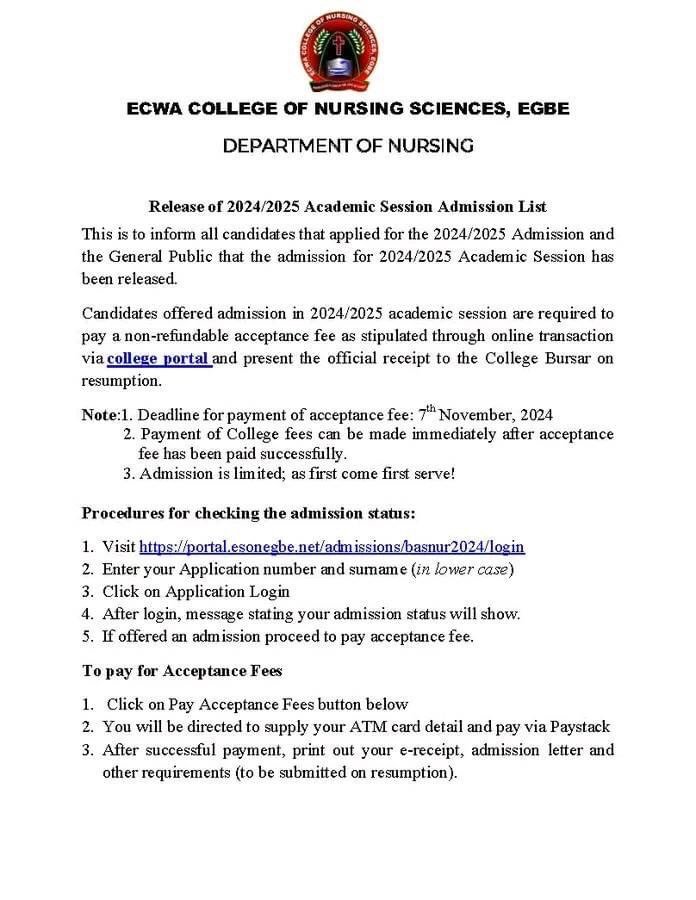
Ecwa College of Nursing Sciences, Egbe 2024/2025 Admission List

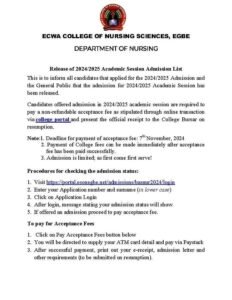
Release Of 2024/2025 Academic Session Admission List

This is to inform all the candidates who applied for 2024/2025 Admission and the General Public that Admission for the 2024/2025 Academic Session has been released.

Candidates offered Admission in the 2024/2025 academic session are required to pay a non-refundable acceptance fee as stipulated through online transactions via the college portal and present the official receipt to the College Bursar on resumption.

Note:

  1. Deadline for the payment of the acceptance fee: 7th November, 2024.
  2. Payment of College fees can be made immediately after the acceptance fee has been successfully paid.
  3. Admission is limited as first come, first serve.

Procedure For Checking Admission Status:

  1. Visit the portal
  2. Enter your Application number and surname (lower case)
  3. Click on Application login
  4. After login, a message stating your admission status will show
  5. If offered an admission, proceed to the payment of Acceptance Fees

To Pay Your Acceptance Fees:

  1. Click on the Payment of Acceptance Fees button below
  2. You will be directed to supply your ATM card details and pay via Paystack
  3. After successful payment, print out your e-receipts, admission letter, and other requirements (to be submitted on resumption)

Mcq On Medical Surgical Nursing

Today, we shall be looking at medical-surgical nursing questions and answers. The aim is to prepare us ahead of any professional exam.

1. The nurse counts an adult’s apical heartbeat at 110 beats per minute. The nurse describes this as:

  1. asystole.
  2. bigeminy.
  3. tachycardia.
  4. bradycardia.

2. A client has an elevated AST 24 hours following chest pain and shortness of breath. This is suggestive of which of the following?

  1. Gallbladder disease
  2. Liver disease
  3. Myocardial infarction
  4. Skeletal muscle injury

3. An adult has a coagulation time of 20 minutes. The nurse should observe the client for which of the following?

  1. Blood clots
  2. Ecchymotic areas
  3. Jaundice
  4. Infection

4. A prothrombin time test should be performed regularly on persons who are taking which medication?

  1. Heparin
  2. Warfarin
  3. Phenobarbital
  4. Digoxin

5. Which prothrombin time value would be considered normal for a client who is receiving warfarin (Coumadin)?

  1. 12 seconds
  2. 20 seconds
  3. 60 seconds
  4. 98 seconds

6. The nurse is caring for a client who is receiving heparin. What drug should be readily available? 1. Vitamin K

  1. Caffeine
  2. Calcium gluconate
  3. Protamine sulfate

7. An adult who is receiving heparin asks the nurse why it cannot be given by mouth. The nurse responds that heparin is given parenterally because:

  1. it is destroyed by gastric secretions.
  2. it irritates the gastric mucosa.
  3. it irritates the intestinal lining.
  4. therapeutic levels can be achieved more quickly.

8. An adult who is admitted for a cardiac catheterization asks the nurse if she will be asleep during the cardiac catheterization. What is the best initial response for the nurse to make?

  1. “You will be given a general anesthesia.”
  2. “You will be sedated but not asleep.”
  3. “The doctor will give you an anesthetic if you
    are having too much pain.”
  4. “Why do you want to be asleep?”

9. During the admission interview, a client who is admitted for a cardiac catheterization says, “Every time I eat shrimp I get a rash.” What action is essential for the nurse to take at this time?

  1. Notify the physician.
  2. Ask the client if she gets a rash from any other
    foods.
  3. Instruct the dietary department not to give the
    client shrimp.
  4. Teach the client the dangers of eating shrimp and other shellfish.

10. The nurse is preparing a client for a cardiac catheterization. Which action would the nurse expect to take?

  1. Administer a radioisotope as ordered.
  2. Give the client a cleansing enema.
  3. Locate and mark peripheral pulses.
  4. Encourage high fluid intake before the test.

11. A young adult with a history of rheumatic fever as a child is to have a cardiac catheterization. She asks the nurse why she must have a cardiac catheterization. The nurse’s response
is based on the understanding that cardiac catheterization can accomplish all of the following EXCEPT:

  1. assessing heart structures.
  2. determining oxygen levels in the heart chambers.
  3. evaluating cardiac output.
  4. obtaining a biopsy specimen.

12. When a client returns from undergoing a cardiac catheterization, it is most essential for the nurse to:

  1. check peripheral pulses.
  2. maintain NPO.
  3. apply heat to the insertion site.
  4. start range of motion exercises immediately.

13. A male client with angina pectoris has been having an increased number of episodes of pain recently. He is admitted for observation. During the admission interview, he tells the nurse that he has been having chest pain during the last week. Which statement by the client would be of greatest concern to the nurse?

  1. “I had chest pain while I was walking in the snow on Thursday.”
  2. “We went out for a big dinner to celebrate my wife’s birthday, but I couldn’t enjoy it because I got the pain before we got home from the restaurant”
  3. “I had chest pain yesterday while I was sitting in the living room watching television.”
  4. “I felt pain all the way down my left arm after I was playing with my grandson on Monday.”

14. The nurse responds to the call light of a client who has a history of angina pectoris. He tells the nurse that he has just taken a nitroglycerin tablet sublingually for anginal pain. What action should the nurse take next?

  1. If the pain does not subside within five minutes, place a second tablet under his tongue
  2. Position him with head lower than feet
  3. Administer a narcotic as needed (PRN) for pain if he still has pain in 10 minutes
  4. Call his physician and alert the code team for possible intervention.

15. The nurse is teaching an adult who has angina about taking nitroglycerin. The nurse tells him he will know the nitroglycerin is effective when:

  1. he experiences tingling under the tongue.
  2. his pulse rate increases.
  3. his pain subsides.
  4. his activity tolerance increases.

16. A client with angina will have to make lifestyle modifications. Which of the following statements by the client would indicate that he understands the necessary modifications in lifestyle to prevent angina attacks?

  1. “I know that I will need to eat less, so I will only eat one meal a day.”
  2. “I will need to stay in bed all the time so I won’t have the pain.”
  3. “I’ll stop what I’m doing whenever I have pain and take a pill.”
  4. “I will need to walk more slowly and rest frequently to avoid the angina.”

17. A client who has been treated for angina is discharged in stable condition. At a clinic visit, he tells the nurse he has anginal pain when he has sexual intercourse with his wife. What is the best response for the nurse to make?

  1. “Do you have ambivalent feelings toward your wife?”
  2. “Many persons with angina have less pain when their partner assumes the top position.”
  3. “Be sure that you attempt intercourse only when you are well rested and relaxed.”
  4. “You might try having a cocktail before sexual activity to help you relax.”

18. A low-sodium, low-cholesterol, weight-reducing diet is prescribed for an adult with heart disease. The nurse knows that he understands his diet when he chooses which of the following meals?

  1. Baked skinless chicken and mashed potatoes
  2. Stir-fried Chinese vegetables and rice
  3. Tuna fish salad with celery sticks
  4. Grilled lean steak with carrots

19. An adult client is admitted with a diagnosis of left-sided congestive heart failure. Which assessment finding would most likely be present?

1. Distended neck veins

  1. Dyspnea
  2. Hepatomegaly
  3. Pitting edema

20. Digoxin (Lanoxin) and furosemide (Lasix) are ordered for a client who has congestive heart failure. Which of the following would the nurse also expect to be ordered for this client?

  1. Potassium
  2. Calcium
  3. Aspirin
  4. Coumadin

21. When the nurse is about to administer digoxin to a client, the client says, “I think I need to see the eye doctor. Things seem to look kind of green today.” The nurse takes his vital signs, which are blood pressure = 150/94, pulse = 60 bpm, and respirations = 28. What is the most appropriate initial action for the nurse to take?

  1. Administer the medication and record the findings on his chart
  2. Withhold the digoxin and report to the charge nurse
  3. Request an appointment with the ophthalmologist
  4. Reassure the client that he is having a normal reaction to his medication

22. An adult client is admitted to the hospital with peripheral vascular disease of the lower extremities. He has several ischemic ulcers on each ankle and lower leg area. Other parts of his skin are shiny and taut with loss of hair. A primary nursing goal for this client should be to do which of the following?

  1. Increase activity tolerance
  2. Relieve anxiety
  3. Protect from injury
  4. Help build a positive body image

23. An adult client who has peripheral vascular disease of the lower extremities was observed smoking in the waiting area. What is the most appropriate response for the nurse to make regarding the client’s smoking?

  1. “Smoking is not allowed for patients with blood diseases.”
  2. “Smoking causes the blood vessels in your legs to constrict and reduces the blood supply.”
  3. “Smoking increases your blood pressure and strains your heart.”
  4. “Smoking causes your body to be under greater stress”

24. An adult client with peripheral vascular disease tells the nurse he is afraid his left leg is not improving and may need to be amputated. How should the nurse respond?

  1. “You and your wife should discuss your feelings before surgery.”
  2. “You sound concerned about your leg and possible surgery.”
  3. “It is better to have an amputation when the ulcers are not improving.”
  4. “You don’t need to be afraid of surgery.”

25. An adult is diagnosed with hypertension. He is prescribed chlorothiazide (Diuril) 500 mg PO. What nursing instruction is essential for him?

1. Drink at least two quarts of liquid daily.

  1. Avoid hard cheeses.
  2. Drink orange juice or eat a banana daily.
  3. Do not take aspirin

26. A low-sodium diet has been ordered for an adult client. The nurse knows that the client understands his low-sodium diet when the client selects which menu?

  1. Tossed salad, carrot sticks, and steak
  2. Baked chicken, mashed potatoes, and green beans
  3. Hot dog, roll, and coleslaw
  4. Chicken noodle soup, applesauce, and cottage cheese

27. A female client is admitted to the hospital with obesity and deep vein thrombophlebitis (DVT) of the right leg. She weighs 275 pounds. Which of the following factors is least related to her diagnosis?

  1. She has been taking oral estrogens for the last three years.
  2. She smokes two packs of cigarettes daily.
  3. Her right femur was fractured recently.
  4. She is 30 years old.

28. Which assessment finding would most likely indicate that a client has thrombophlebitis in the leg?

  1. Diminished pedal pulses
  2. Color changes in the extremities when elevated
  3. Red, shiny skin
  4. Coolness and pallor in the leg

29. What should be included in the teaching plan for an adult who has hypertension?

  1. Reduce dietary calcium.
  2. Avoid aerobic exercise.
  3. Reduce alcohol intake.
  4. Limit fluid intake.

30. The nurse is caring for an elderly client who has congestive heart failure and is taking digoxin. The client should be monitored for which of the following signs of toxicity?

  1. Disorientation
  2. Weight gain
  3. Constipation
  4. Dyspnea

31. The licensed practical nurse (LPN) is assisting the registered nurse (RN) in developing the nursing care plan for an older adult who has congestive heart failure. Which nursing diagnosis is most likely to be included?

  1. Deficient fluid volume
  2. Impaired verbal communication
  3. Chronic pain
  4. Activity intolerance

32. The nurse is caring for a client who is being evaluated for arteriosclerosis obliterans. Which complaint is the client most likely to have?

  1. Burning pain in the legs that wakens him or her at night
  2. Numbness of the feet and ankles with exercise
  3. Leg pain while walking that becomes severe enough to force him or her to stop
  4. Increasing warmth and redness of the legs when they are elevated

33. An adult is admitted with venous thromboembolism. What treatment should the nurse expect during the acute stage?

  1. Application of an elastic stocking
  2. Ambulation three times a day
  3. Passive range of motion exercises to the legs
  4. Use of ice packs to control pain

34. The nurse is observing a client who is learning to perform Buerger-Allen exercises. The nurse knows that the client is performing these exercises correctly when the client is observed doing what? Alternately dorsiflexing and plantar flexing the feet while the legs are elevated

  1. Massaging the legs beginning at the feet and moving toward the heart
  2. Alternately walking short distances and resting with the legs elevated
  3. Elevating the legs, then dangling them, and then lying flat for three minutes in each position

35. What should be included in foot care for the client who has a peripheral vascular disorder?

  1. Soaking the feet for 20 minutes before washing
    them
  2. Walking barefoot only on carpeted floors
  3. Applying lotion between the toes to avoid cracking of the skin
  4. Avoiding exposure of the legs and feet to the sun

36. An adult male is being evaluated for possible dysrhythmia and is to be placed on a Holter monitor. What instructions should the nurse give him to ensure that this test provides a comprehensive picture of his cardiac status?

  1. Remove the electrodes intermittently for hygiene measures.
  2. Exercise frequently while the monitor is in place.
  3. Keep a diary of all your activities while being monitored.
  4. Refrain from activities that precipitate
    symptoms.

37. An older adult is scheduled for coronary arteriography during a cardiac catheterization. Which nursing intervention will be essential as she recovers from the diagnostic procedure on the hospital unit?

  1. Encouraging frequent ambulation to prevent deep vein thrombosis
  2. Limiting fluid intake to prevent fluid overload
  3. Limiting dietary fiber to prevent diarrhea
  4. Assessing the arterial puncture site when taking vital signs

38. An older adult is admitted to the hospital with symptoms of severe dyspnea, orthopnea, dia- phoresis, bubbling respirations, and cyanosis. He states that he is afraid “something bad is about
to happen.” How should the nurse position this client?

  1. Sitting upright
  2. Head lower than feet
  3. Supine
  4. Prone

39. An adult male has a high level of high-density lipoproteins (HDL) in proportion to low-density lipoproteins (LDL). How does this relate to his risk of developing coronary artery disease (CAD)?

  1. His risk for CAD is low.
  2. There is no direct correlation.
  3. His risk may increase with exercise.
  4. His risk will increase with age.

40. A 72-year-old man had a total hip arthroplasty eight days ago. He suddenly develops tenderness in his left calf, a slight temperature elevation, and a positive Homan’s sign. Which of the following will be included in the initial care of this man?

  1. Warm packs to the left leg
  2. Vigorous massage of the left leg
  3. Placing the left leg in a dependent position
  4. Performing range of motion exercises to the left leg.

ANSWERS AND RATIONALES

  1. 3. Tachycardia in an adult is defined as a heart rate above 100 beats per minute. Asystole is cardiac arrest. There is no heartbeat. Bigeminy means that the heartbeats are coming in pairs.
    Bradycardia in an adult is defined as a heart rate of 60 beats or less per minute.
  2. 3. AST is an enzyme released in response to tissue damage. The symptoms are suggestive of myocardial damage. AST rises 24 hours after
    a myocardial infarction. It will also rise when there is liver damage and skeletal muscle injury. This client has symptoms typical of myocardial infarction. Gallbladder disease may present with pain in the right scapula (shoulder blade) region but would not have an elevated AST.
  3. 2 The normal clotting time is 9 to 12 minutes. A prolonged clotting time would suggest a bleeding tendency; the client should be observed for signs of bleeding, such as ecchymotic areas. Blood clots would occur with a clotting time of less than normal. Jaundice occurs with liver damage or rapid breakdown of red blood cells, such as is seen in sickle cell anemia. Infection occurs when there are too few white blood cells.
  4. 2. A prothrombin time test is done to determine the effectiveness of warfarin. A partial thromboplastin time test is done for persons taking heparin. Phenobarbital and digoxin do not require regular clotting tests. Serum levels of these drugs may be done if the client is on long-term therapy.
  5. 2. When a client is receiving Coumadin, the prothrombin time should be 1.5 to 2 times the normal value, which is 11 to 12.5 seconds. Twenty seconds falls within that range. Twelve seconds
    is normal for someone who is not receiving Coumadin. Sixty seconds is normal for a partial thromboplastin time (PTT) test. Ninety-eight seconds on a PTT would be acceptable for a client who is receiving heparin. It should be 1.5 to 2 times the normal range of 60 to 70 seconds.
  6. 4. The antidote for heparin is protamine sulfate. Vitamin K is the antidote for Coumadin. Calcium gluconate is the antidote for magnesium sulfate. Caffeine is a central nervous system stimulant and will increase alertness and heart rate.
  7. Heparin is a protein and is destroyed by gastric secretions. It is given either intravenously or subcutaneously for that reason.
  8. Persons who are undergoing cardiac catheterization will receive a sedative but are not put to sleep. Their cooperation is needed during the procedure. Asking “why” makes the client defensive and is not appropriate for this client at this time. Give the client the information asked for.
  9. Allergy to shellfish is indicative of an allergy to iodine. The dye used in a cardiac catheterization is an iodine dye. Anaphylactic reactions can occur. Because the exam is scheduled for the morning, the nurse should notify the physician immediately. The other actions might have relevance but are not essential (safety related) at this time.
  10. 3. It is essential to monitor peripheral pulses after the procedure. They should be assessed before the procedure to determine location and baseline levels. An iodine dye is used during a cardiac catheterization, not a radioisotope. There is no need to give the client an enema. Fluids may be encouraged after the test. The client will be NPO for eight hours before the test.
  11. 4. A biopsy specimen cannot be obtained during a cardiac catheterization. Heart structures can be assessed, oxygen levels in the heart chambers can be determined, and cardiac output can be measured during a cardiac catheterization.
  12. 1. Checking peripheral pulses is of highest priority. The complications most likely to occur are hemorrhage and obstruction of the vessel. The client is NPO before the procedure, not after. Cold may be applied to the insertion site to vasoconstrict. Heat vasodilates and is contraindicated because it might cause bleeding. Range of motion exercises might cause bleeding. The extremity used for the insertion site is
    kept quiet immediately following a cardiac catheterization.
  13. 3. This answer indicates pain at rest, which suggests a progression of the angina. The other answers all indicate pain with known causes of angina, such as exercise, cold environment, or eating.
  14. 1. Nitroglycerin can be given at five-minute intervals for up to three doses if the pain is not relieved. Positioning with head lower than feet increases cardiac workload and would make the client worse. PRN narcotics are not usually ordered for clients who have anginal pain. Nitroglycerin, a vasodilator, is usually the medication of choice. At some point, the physician will need to be called, but there is no need to alert the code team for possible intervention.
  15. 3. Pain relief is the expected outcome when taking nitroglycerin. Vasodilation of coronary vessels will increase the blood supply to the heart muscle, decreasing pain caused by ischemia. Tingling under the tongue and a headache indicate that
    the medication is potent. His pulse rate should decrease when the pain is relieved. Increase in activity tolerance is nice, but nitroglycerin is given to relieve anginal pain.
  16. 4. Walking more slowly and resting decreases energy expenditure and prevents an attack. Answer 3 treats an attack. By the time he has pain, he is experiencing angina. To prevent angina,
    he needs to walk slowly and rest frequently. He should eat small, frequent meals—not one large meal. He should exercise within his tolerance level. Staying in bed predisposes the client to the complications of immobility, such as clots and pneumonia.
  17. 2. Reducing his physical activity reduces the cardiac workload. This response suggests a
    way that he can engage in sexual activity with minimum strain on the heart. Ambivalent feelings toward his wife are unlikely to cause anginal pain. There is some truth to being well rested and relaxed, but telling him that this is the only time he should have intercourse is not realistic. The nurse should not advise the client to have an alcoholic beverage before sexual activity.
  18. 1. Chicken is lower in sodium than beef or seafood. Baking adds no sodium to the chicken. Barbecuing adds sodium and fat, and frying adds fat and usually sodium. Mashed potatoes contain little sodium. Chinese food is usually high in sodium. Tuna fish and celery are high in sodium. Steak and carrots are high in sodium.
  19. 2. Dyspnea occurs with left-sided heart failure. Distended neck veins, hepatomegaly, and pitting edema are signs of right-sided heart failure.
  20. 1. Lasix is a potassium-depleting diuretic. Digoxin toxicity occurs more quickly in the presence of a low serum potassium. Potassium supplements are usually ordered when the client is on a potassium- depleting diuretic. There is no indication for supplemental calcium. Aspirin and Coumadin are anticoagulants and are not indicated because the client is taking Lasix and digoxin.
  21. 2. Disturbance in green and yellow vision is a sign of digoxin toxicity. A pulse of 60 is borderline for digoxin toxicity. When there is any possibility
    of digoxin toxicity, withhold the medication and report to the charge nurse. Once a person takes digoxin, it stays in the system for nearly a week. The LPN will of course record the findings, but withholding the medication is essential. The client needs to have serum digoxin levels done and does not need to be seen by an ophthalmologist. Visual disturbances are a sign of digoxin toxicity, but these are not normal.
  22. 3. Because the client has such poor blood supply to his legs, the nurse must be very careful to protect him from injury. Increasing activity tolerance might be desirable but is certainly not the primary nursing goal. Note that the question does not indicate that he has poor exercise tolerance. There are no data in the question to indicate that the client is anxious. He may need help in building a positive body image because his legs are disfigured, but this is certainly not a high priority.
  23. 2. This is an accurate answer that relates his behavior to his illness. All of the other statements are true about smoking but do not relate to his current health problem.
  24. 2. This response opens communication and allows him to talk about his feelings. The other answers do not allow him to discuss his feelings with the nurse now.
  25. 3. Chlorothiazide (Diuril) is a potassium-depleting diuretic. Orange juice and bananas are good sources of potassium. It is not necessary to increase fluids to two quarts when the client is taking a diuretic. Hard cheeses should be avoided when the client is taking monoamine oxidase inhibitors (MAOIs). MAOIs are antidepressants. People who take Coumadin should not take aspirin.
  26. 2. Chicken is low in sodium, as are mashed potatoes and green beans. Carrot sticks, steak, hot dogs, soup, and cottage cheese are all high in sodium.
  27. 4. Age is least related to DVT. Oral estrogens, smoking, and a broken leg are all risk factors for DVT.
  28. 3. Red, shiny skin suggests inflammation. Diminished pedal pulses and color changes in the extremities when elevated are indicative of arterial insufficiency, not a clot in the vein. Coolness and pallor do not suggest inflammation; redness and warmth suggest inflammation.
  29. 3. High alcohol intake contributes to increases in blood pressure. Hypertensive clients are usually advised to limit alcohol intake to the equivalent of two glasses of wine or less per day. Dietary sodium should be limited in people with hypertension; however, dietary calcium is not a contributing factor in hypertension. Aerobic exercise is helpful in controlling high blood pressure. It may also contribute to weight reduction, which can help decrease blood pressure. Restriction of fluid intake is a medical order and is not appropriate advice for a nurse to give. Fluid restriction is avoided unless other measures are not successful.
  30. 1. Disorientation and confusion are often the first signs of digitalis toxicity in the elderly. Weight gain and dyspnea are not signs of digoxin toxicity.
    They might indicate exacerbation of congestive heart failure. Diarrhea, not constipation, is a sign of digoxin toxicity. Constipation could occur if the client has restricted activity.
  31. 4. Dyspnea and impaired oxygenation of tissues reduce the client’s ability to tolerate exercise. Excess fluid volume, manifested by edema,
    is much more likely to occur with congestive heart failure (CHF) than deficient fluid volume. Impaired verbal communication would describe dysphasia, which occurs with cerebrovascular accident (CVA), not CHF. Acute pain may occur with CHF when exacerbations occur. Chronic pain does not usually occur with CHF.
  32. 3. Severe leg pain while walking describes intermittent claudication, which is the most common symptom of arteriosclerosis obliterans. Pain at rest develops in the late stages of the disease. Pain is much more likely than numbness with exercise. Paresthesias (including numbness) do occur, but they are likely at rest. The legs and feet of the client with arteriosclerosis obliterans become cool and pale when elevated
    because there is not enough blood flow to the extremities.
  33. 1. Compression bandages or stockings help prevent edema and promote adequate venous blood flow and are a major element in the treatment of venous thromboembolism. Bed
    rest is appropriate in the acute stage of venous thromboembolism. Any form of exercise of the legs would increase the risk of pulmonary emboli. Heat is appropriate in the treatment of venous thromboembolism. Ice causes vasoconstriction, which decreases blood flow to the extremities.
  34. 4. In Buerger-Allen exercises, the feet are elevated until they blanch, then dangled until they redden, and then stretched out while the client is lying flat. This promotes arterial circulation to the feet. Dorsiflexing and plantar flexing the feet help to maintain range of motion but are not Buerger- Allen exercises. The client with peripheral vascular disease should never massage the legs because of the high risk of dislodging a thrombus if one is present. Walking promotes venous circulation but is not a Buerger-Allen exercise.
  35. 4. Sunburn would damage the already fragile skin, increasing the risk of ulceration and infection. Feet should not be soaked. Soaking leads to maceration, predisposing to skin breakdown or infection. The client with a peripheral vascular disorder should never walk barefoot. Small sharp objects such as pins may not be visible in carpet and could be stepped on. Lotion may be applied to dry areas of the legs and feet but must be avoided between the toes, where the excess moisture causes maceration. Ingredients in lotion provide a nutrient source for bacteria and fungi, increasing the infection risk if cracks in the skin occur.
  36. 3. The client should function according to his normal daily schedule unless directed to do otherwise by the physician. Keeping a diary or log of these daily activities is necessary so that it can be correlated with the continuous ECG monitor strip to determine whether the dysrhythmia occurs during a certain activity or at a particular time of day. The Holter monitor is usually worn for only 24 hours, so it is not necessary to change the leads. Activities that precipitate symptoms may be correlated with a dysrhythmia that can be treated, preventing further symptoms from occurring. Therefore, it would be helpful if the client were symptomatic while attached to the Holter monitor.
  37. 4. Following a cardiac catheterization in which an arterial site is used for access, the puncture
    or cutdown site should be assessed at least as often as vital signs are monitored. The client is
    at risk for development of bleeding, hemorrhage, hematoma formation, and arterial insufficiency
    of the affected extremity. When the arterial access site is used, the client is on strict bed rest for at least several hours. Fluids are encouraged after catheterization to increase urinary output and flush out the dye used during the procedure. There is no need to restrict dietary fiber. In fact, constipation can be dangerous for cardiac clients if they strain at stool (Valsalva maneuver.)
  38. 1. The client’s symptoms suggest pulmonary edema. Any client with severe dyspnea,
    orthopnea, and bubbling respirations needs to be in an upright position. An upright position decreases venous return to the heart by allowing blood to pool in the extremities. Decreasing venous return lowers the output of the right ventricle and decreases lung congestion. Sitting upright also allows the abdominal organs to fall away from the diaphragm, easing breathing. Positioned with head lower than feet would not promote venous pooling in the extremities and would increase venous return and pulmonary congestion. The supine position also would contribute to increased pulmonary congestion. The prone position, lying on the abdomen, does not decrease venous return, which is what this client desperately needs.
  39. 1. Although elevated LDL levels in proportion to HDL levels are positively correlated with CAD, elevated HDL levels in proportion to LDL levels may decrease the risk of developing CAD. HDL levels may increase with exercise, thereby decreasing a client’s risk of CAD. Age is not a predictor of HDL and LDL levels.
  40. 1. Warm, moist heat applied to the extremity reduces the discomfort associated with thrombophlebitis. Vigorous massage of the leg is contraindicated in any client because it may cause a thrombus to become dislodged and possibly cause a pulmonary embolus. The leg should be elevated to prevent venous stasis. Leg exercises are used to prevent thrombophlebitis; once a client has thrombophlebitis, the leg is not exercised to prevent the thrombus from becoming an embolus.