Home Blog Page 18

How To Pass Principles Of Management During Nursing Professional Exams

Let’s quickly have an OVERVIEW ON MANAGEMENT

Going through 2017 Midwifery PAST QUESTIONS.
There are many past question which has to do expecially with Principle of management. Let’s briefly talk about it, and answer the questions on it.

What is management?

Management can be defined as a process of getting the work or the task done that is required for achieving the goals of an organisation in an efficient and effective manner.

Nursing Management

Nursing management consists of the performance of the leadership functions of governance and decision-making within organizations employing nurses. It includes processes common to all management like planning, organizing, staffing, directing and controlling.

Major Management Of A Nurse/Midwife

  1. Organising
  2. Staffing
  3. Scheduling
  4. Directing
  5. And delegation

Principles Of Management

Henry Fayol, also known as the Father of Modern Management Theory, gave a new perception on the concept of management. He introduced a general theory that can be applied to all levels of management and every department. He envisioned maximising managerial efficiency. Today, Fayol’s theory is practised by the management to organise and regulate the internal activities of an organisation.

The fourteen principles of management created by Henri Fayol are explained below.

  1. Division of Work/LABOUR

Henri believed that segregating work in the workforce amongst the workers will enhance the quality of the product. Similarly, he also concluded that the division of work improves the productivity, efficiency, accuracy and speed of the workers. This principle is appropriate for both the managerial as well as a technical work level.

2. Authority and Responsibility

These are the two key aspects of management. Authority facilitates the management to work efficiently, and responsibility makes them responsible for the work done under their guidance or leadership.

3. Discipline

Without discipline, nothing can be accomplished. It is the core value for any project or any management. Good performance and sensible interrelation make the management job easy and comprehensive. Employees’ good behaviour also helps them smoothly build and progress in their professional careers.

4. Unity of Command

This means an employee should have only one boss and follow his command. If an employee has to follow more than one boss, there begins a conflict of interest and can create confusion.

5. Unity of Direction

Whoever is engaged in the same activity should have a unified goal. This means all the people working in a company should have one goal and motive which will make the work easier and achieve the set goal easily.

6. Subordination of Individual Interest

This indicates a company should work unitedly towards the interest of a company rather than personal interest. Be subordinate to the purposes of an organisation. This refers to the whole chain of command in a company.

7. Remuneration

This plays an important role in motivating the workers of a company. Remuneration can be monetary or non-monetary. Ideally, it should be according to an individual’s efforts they have put forth.

8. Centralization

In any company, the management or any authority responsible for the decision-making process should be neutral. However, this depends on the size of an organisation. Henri Fayol stressed on the point that there should be a balance between the hierarchy and division of power.

9Scalar Chain

Fayol, on this principle, highlights that the hierarchy steps should be from the top to the lowest. This is necessary so that every employee knows their immediate senior also they should be able to contact any, if needed.

10. Order

A company should maintain a well-defined work order to have a favourable work culture. The positive atmosphere in the workplace will boost more positive productivity.

11. Equity

All employees should be treated equally and respectfully. It’s the responsibility of a manager that no employees face discrimination.

12. Stability

An employee delivers the best if they feel secure in their job. It is the duty of the management to offer job security to their employees.

13. Initiative

The management should support and encourage the employees to take initiatives in an organisation. It will help them to increase their motivation and morale.

14. Esprit de Corps

It is the responsibility of the management to motivate their employees and be supportive of each other regularly. Developing trust and mutual understanding will lead to a positive outcome and work environment.

The 14 Principles of Management serve as the pillars of any organisation as well as Midwifery profession. They are integral for prediction, planning, decision-making, process management, control and coordination in given out a quality care to client and patients.

Important Of 14 Principles Of Management To a Midwife

  • The principles of management allows THE MIDWIFE to understand how to run an organisation.
  • It also helps HER to accomplish tasks and manage situations as and when they arise in the organisation.

Leadership In Management In Nursing Profession

Both management and leadership are necessary skills, and they often overlap with one another. In most settings, the role of a manager includes both leadership and management functions. Leadership skills are needed to set the vision, and management skills are needed to implement a plan to achieve that vision. Recognizing the difference between leadership and management, however, can help individuals focus on developing their skills in both arenas. The greatest success comes when strong leadership is paired with effective management.

Types Of Leadership In Nursing Profession

There are 2 major types of leadership

  1. Formal
  2. Informal leader

As we attempt to understand what leadership is all about, it is worth noting that not all leadership is based on official position. That is, the title and official role of an individual within an organization do not always correspond to his actual leadership influence.

1. Formal Leader

Generally speaking, individuals who are assigned titles and positions of authority are expected to provide leadership. Because that leadership role is officially recognized, this is known as formal leadership. Unfortunately, there are plenty of individuals who have formal leadership positions but do not actually provide strong leadership. This is often problematic and can leave the organization lacking direction and purpose.

2. Informal Leader

However, there are also individuals who do not have official positions of leadership but who do exhibit leadership qualities and practices. They help create the company vision with innovative ideas, and they inspire and motivate their coworkers. When leadership is exhibited without an official position, it is known as informal leadership. This is a valuable trait for a midwife to have.

Fundamental Of Leadership

  1. self-awareness
  2. learning agility,
  3. influence,
  4. and communication

THE 4 E OF LEADERSHIP

Jack Welch, a legendary leader who has inspired generations of leaders to think beyond their imagination, helped develop in GE a very effective leadership assessment that is easily transferred to other industries. The assessment details the 4Es of leadership OF WHICH ARE

  1. energy
  2. energize,
  3. edge, and
  4. execution

THE 4 S OF LEADERSHIP

The 4 S rule in leadership.

  1. Simple,
  2. solution,
  3. sustainable
  4. and smile

Types Of Leadership Styles

There are majorly 4 types of leadership styles this includes

  1. Autocratic.
  2. Democratic
  3. Laissez-faire.
  4. Transformational.

Leader In Nursing

A leader is a person who aims to inspire people and motivate them towards a goal.

Let us briefly take a look at some past questions that has to do with management.

  1. A leader who does not trust self or others to make decisions but relies on the organizations rules and policies is a……………… Leader

A. Democratic
B. Laissez-faire
C. Bureaucratic
D. Autocratic

  1. The number of subordinates a superior or manager may effectively supervise or manage is referred to as

A. Span of responsibility
B. Span of control
C. Unity of direction
D. Unity of command

Midwifery Exam 2023 Past Questions And Answers


1. The third stage of digestion begins in the 

A. Stomach b. duodenum c. mouth d. small intestine

2. The premolars of the teeth are also known as

A. Cuspids b. Bicuspids c. Tricuspids d. wisdom teeth


3. How many canines are in each jaw?

a. 2 b. 4 c. 6 d. 8


4. Which of these performs both respiratory and digestive funtions?

A. Larynx b. Esophagus c. Pharynx d. Oral cavity


5. Anatomically, the esophagus is divided into ___ parts?

A. 2 b. 3 c. 4 d. 5


6. The stomach has ____ distinct sections?

A. 3 b. 4 c. 5 d. 6


7. The largest section of the stomach is known as 

A. Cardia b. Fundus c. Antrum d. Corpus


8. Meissner Plexus of nerve is found in the ____ of the stomach?

A. Peritoneum b. Muscular layer c. Submucous layer d. Mucous membrane layer


9. Which of these produces hyaluronic acid?

A. Chief cells b. Oxyntic cells c. Endocrine cells d. Mucous neck cells


10. _____ lies in the umbilical and hypogastric region of the abdominal cavity?

A. Stomach b. small intestine c. large intestine d. pancreas


11. Arterial blood supply to the ascending colon is by?

A. Superior gastric arteries b. Inferior gastric arteries c. Superior mesentric arteries

d. inferior mesentric arteries

12. The following are accessory organs of the GIT except?

A. Liver b. Gall bladder c. Pancreas d. Lingual gland


13. Examples of smaller salivary gland include?

A. Parotid b. labial c. sublingual d. submandibular


14. The largest gland in the human body is ?

A. Pancreas b. kidney c. spleen d. liver 


15. Anatomically, the liver is subdivided into ____ lobes?

A. 2 b. 3 c. 4 d. 5


16. Excess glucose in the body is a condition known as ?

A. Type 1 diabetes b. Type II diabetes c. Hyperglycemiad. Hyperglucoma


17. The pancreas is a heterocrine gland whose endocrine function is ?

A. 1% b. 25% c. 99% d. 75%


18. The most common cell of the islet of langerhans is ?

A. Alpha cells b. Beta cells c. Delta cells d. F cells


19. Insulin in the bloodstrean has a half-life span of _____minutes?

A. 3 b. 4 c. 5 d. 6


20. The moment food enters into the stomach, it brings about a reflex action called ?

A. Gastro-rectal reflex b. Gastro-intestinal reflex c. Gastro-iliac reflex d. Gastro-colic reflex


21. The exchange of gases between the alveolar sac and the blood takes place in the ?

A. Lungs b. Tissue c. Blood d. Nose


22. Internal respiration occurs in the ? 

A. Lungs b. Tissue c. Blood d. Nose


23. Which of these is NOT a function of the respiratory system ?

A. Olfaction b. Protection c. Gustation d. Voice production


24. An enzyme produced by the lungs ACE means ?

A. Angiotensin Conducting Enzyme b. Aldosterone Converting Enzyme 

c. Aldosterone Conducting Enzyme d. Angiotensin Converting Enzyme


25. Atmospheric pressure at sea level is ?

A. 360mmHg b. 520mmHg c. 180mmHg d. 760mmHg


26. Which of these gases is not present in the atmosphere ?

A. Oxygen b. Carbondioxide c. Nitrogen d. Hydrogen


27. The percentage of Oxygen in inspired air is ?

A. 78% b. 0.04% c. 4.04% d. 21%


28. The partial pressure of Oxygen in alveolar air is ?

A. 40mmHg b. 573mmHg c.104mmHg d. 44mmHg


29. CO2 is transported in Blood in all these ways except ?

A. As carbon monoxide b. Dissolved in plasma c. as HCO-3 d. binded to Haemoglobin


30. Which of these is NOT an organ of respiration?

A. Nose b. Oesophagus C. Trachea D. Lungs


31. The structure that separates the two nasal cavities is called the ___

A. Septum B. Bridge C. Cartilage D. Bone


32. The opening that conveys tears from the conjuctivalsac to the nose is called ?

A. Anterior nares B. Naso-lacrimal duct C. Posterior nares D. Maxillary antrum


33. The maximum volume of air that the lungs can accommodate is called ?

A. Inspiratory capacity B. Vital capacity C. Total lung capacity D. Residual Volume


34. The amount of air inspired and expired during a normal breath is ?

A. Residual volume B. Inspiratory Reserve volume C. Expiratory Reserve volume D. Tidal Volume


35. The structure referred to as the voice box is the ?

A. Pharynx B. Larynx C. Trachea D. Bronchus


36. Which of these is NOT part of the wall of a trachea?

A. Mucosa B. Arytenoids C. Submucosa D. Adventitia


37. The area where actual exchange of gases between the blood takes place is called ?

A. Pulmonary unit B. Bronchi C. Trachea D. Larynx


38. Which of these is a main muscle involved in respiration?

A. Trapezius B. Diaphragm C. Sternocleidomastoid D. Pectoralis major


39. Which of these is NOT a medistinal structure?

A. Heart B. Trachea C. Diaphragm D. Oesophagus


40. An inflammation of the Larynx due to overuse, irritation or infection is called ?

A. Pneumonia B. Bronchitis C. Tonsillitis D. Laryngitis


41. The amount of blood found in a 70 Kg adult is ?

A. 10litres B. 2litres C. 6litres D. 12 litres


42. The blood makes up about ___% of the total body weight ?

A. 10 B. 12 C. 8 D.5


43. All the following substances are suspended in the plasma except ?

A. Food nutrients B. Melanin C. Mineral Salts D. Gases


44. There are 42 litres of water in the human body. If 28litres are ICF, how many litres will be ECF?

A. 20 litres B. 14litres C. 24litres D. 10litres


45. Haemoglobin count in an adult male is about ____ of blood?

A. 16gm/100ml B. 20gm/100ml C. 24gm/100ml D. 28gm/100ml


46. The suceeding stages in the development of red blood cells is called ?

A. Erythropoiesis B. Haemocytoblast C. Diapedesis D. Phagocytosis


47. Which of these is NOT a granular leucocyte?

A. Neutrophil B. Eosinophil C. Basophil D. Monocyte


48. The blood vessels that carry oxygenated blood away from the heart are called ?

A. Veins B. Ducts C. Capillaries D. Arteries


49. If there is neither agglutinogen A nor B in the red blood cell of an individual, the person belongs to blood group ?

A. A   B. B   C. AB  D. O


50. A person with blood group A, has agglutinin __

A. A   B. B   C. A&B   D. No agglutinin


51. People with Agglutnin D (Rhesus +) are about ____ of the world population 

A. 50%  B. 15%  C. 85%  D. 75%


52. Blood group __ is a univeral donor 

A. O B. A C. B D. A&B


53. Which of these is NOT required for blood clotting?

A. Lymphoctye B. Prothrombin C. Fibrinogen D. Thromboplastin


54. The ____ is the innermost layer of the heart 

A. Serous Pericardium B. Myocardium C. EndocardiumD. Fibrous Pericardium


55. The wave of expansion of the arteries initiated by each ventricular contraction is called ?

A. Spam B. Pulse C. Rhythm D. Heartbeat


56. ____means that the heart is beating too fast

A. Fibrillation B. Bradycardia C. Tachycardia D. Diastole


57. Which of these is NOT a pulse point?

A. Temporal artery B. Brachial Artery C. Carotid arteryD. Iliac artery


58. ____is the force exerted by the blood against the walls of the blood vessels 

A. Blood pressure B. Pulse C. Tachycardia D. Fibrillation


59. The lymphatic nodes that filter the lymph of the arm and the breast is ?

A. Popliteal node B. Axillary node C. Iliac node D. Inguinal node


60. The largest lymph organ in the body is ?

A. Spleen B. Appendix C. Adenoids D. Tonsils


61. Which is the longest phase of cell cycle?

A. Mitosis B. Meiosis C. Interphase D. Cell Division


62. What type of feedback is involved in Thermoregulation?

A. Negative B. Positive C. None of the above D. All of the above


63. Band of tissue that attach bone to bone is called ?

A. Tendon B. Ligament C. Neuron D. Fiber


64. The removal of tissue sample from patient for diagnosis is called?

A. Autopsy B. Hematology C. Biopsy D. Histology

65. The part of the trunk immediately inferior to the neck is 

A. Abdomen B. Pelvic C. Chest D. Diaphragm 


66. Mesothelium is found in 

A. Serous membrane B. Pleural membrane c. Mucous membrane D. Cutaneous membrane


67. Bone forming cells are called 

A. Osteocytes B. fibroblast  C. Osteoblast D. Chondroblast


68. Which of the following is multi-nucleated 

A. Smooth muscle B. Cardiac Muscle C. Epithelial muscle D. Skeletal muscle


69. Body membrane do not include ?

A. Dura membrane B. Pericardia membrane C. Pleural membrane D. Cutaneous membrane


70. The palm faces downward when the forearm is ?

A. Supinated B. Pronated C. Flexed D. Extended


71. Nuclear envelope disappear at 

A. Anaphase B. Telophase C. Prophase D. Interphase


72. The movement of the body part towards the mid-line is 

A. Adduction B. Abduction C. Extension D. Flexion


73. Dense irregular elastic tissues are found in 

A. Ligaments B. Large arteries C. Adipose tissue D. Dermis 


74. This is not an adult connective tissue 

A. Bone B. Blood C. Wharton’s jelly D. Adipose

75. Cytokinesis begins in 

A. Anaphase B. Telophase C. Prophase D. Metaphase


76. Muscle tissue that is short and spindle in shape is 

A. Smooth muscle B.Cardiac muscle C. Skeletal muscle D. Tendon


77. D.N.A replication occur during 

A. G1 Phase B. G2 Phase C. G3Phase D. S-Phase


78. Cartilage that is found in the pressure regions of the body is 

A. Elastic cartilage B. Hyaline cartilage C. FibrocartilageD. Pressure cartilage


79. Ureter is composed of

A. Squamous epithelium B. Transitional epithelium C. Columnar epithelium 

D. Cuboidal epithelium 


80. In negative feedback, the mechanism that detects change in  the environment is called 

A. Control centre B. Receptor C. effectors D. Adjuster


81. Which of these is used for grinding?

A. Incisors B. Canine C. Premolars D. Molars 


82. The narrowest and collapsible part of the GIT is

A. Esophagus B. Epiglottis C. Pharynx D. Larynx


83. The length of the small intestine is 

a. 600-700cm B. 650-750cm C. 670-760cm D. 680-780cm


84. The Vermiform appendix is found below the ___ junction

A. Rectocecal B. Iliorectal C. Iliosacral D. Iliocecal


85. Salivary glands are secreted under the following conditions except 

A. Electrical B. Thermal C. Mechanical D. Chemical 


86. Which of these is a wedge-shaped organ

A. Pancreas B. Kidney C. Spleen D. Liver


87. The hepatic artery supplies ____percentage of blood into the liver

A. 20% B. 40% C. 60% D. 80% 


88. Which of these is not a bone in the upper limb

A. Humerus B. Femur C. Radius D. Carpal Bones


89. Abnormal posterior convex curve of the thoracic vertebra is called

A. Lordosis B. Scoliosis C. Kyphosis D. Curvosis


90. Stratified epithelium is found in areas of the body where the principal activity is 

A. Filtration B. Absorption C. Protection D. Secretion


91. The following are the protein fibers found in the connective tissues except

A. Elastic fiber B. Reticular fiber C. Collagen fiber D. Elastin fiber


92. The structural and functional unit of bone called the

A. Lacunae B. Lamellae C. Osteon D. Osteocyte


93. Skin burn that result into blister and excessive pain is 

A. First degree burn B. Full thickness burn C. Second degree burn D. Third degree burn


94. Nails are derivatives of 

A. Stratum basale B. Stratum spinosum C. Stratum Corneum D. Stratum Granulosum


95. How many organ system is in the body 

A. 10 B. 9 C. 11 D. 12


96. During interphase, the DNA appears as a fine network of thread called the 

A. Chromatids B. Chromosome C. Chromatin D. Centrioles

97. Which of these organelles produces large amount of Adenosine Triphosphate

A. Endoplasmic reticulum B. Lysosomes C. Mitochondria D. Ribosome


98. The type of tissue that is found in the liver is

A. Reticular tissue B. Papillary tissue C. Elastic tissue D. Collagenous tissue


99. The cells and glands that carried out body responses are called

A. Receptors B. regulator C. Effectors D. Connectors

100. The following are adult connective tissue except

A. Wharton’s jelly (b) Connective tissue proper (c) Bone D. Blood

Click here to see 200 Midwifery Past Questions and Answers

Click here to see Nursing Council Exam Past Questions And Answers

Nursing Past Questions and Answers For Nursing Students Preparing For Exams (NMCN)


INSTRUCTIONS:
Professional Examination for Midwives
March, 2019 PAPER I
|

SECTION B: OBJECTIVE QUESTIONS (40%) Answer ALL questions

The following are Objeçtive Test.

Circle the appropriate uption witlh BIRO. Each question counts for ONE (I) mark.

  • The blood supply to the vulva is from the (a) Internal iliac artery
    (b) Renal artery
    (C) Internal and cxiernal pudendal arteriçs
    (d) (Ovárlan artery
  • The bony prominence felt in Iron of the iliac crest is called the (a) lilac l’ossa
    (b) Iliac spine (c) lliac angle
    (d) lliac depression
  • The developmental abnormality ol’ the pelvic bond in which one ‘sacral ala is
    nissis, is called
    (aJ Nacgcle’ s pelvis
    (b) Robert’s pelvis (c) Scoliosis
    (d) Kyphosis
  • The false pelvis is bounded posteriorly by the (a) Iliac fossau (b)-4bdominal wall (e) Obturator foramén (d), T.umbar vertebrae.
  • The anatomical conjugate measures about (a) 10cm (b) 11 cm (c) 12cm (d) 13cm
  • The following can result in developmental abnormality of the pelvis EXCEPT: (a) Fetal compromise (b) Injury to the pelvis (c) Dietary deficiencies (d) Disease conditions
  • The average blood loss during normal menstrual cycle is estimated between: (a) 20—50ml (b) 30—100ml (c) 50—150 ml (d) 70— 150 ml
  • Which of the following types of pelvis is kidney-shaped: (a) Android pelvis (b) Platypelloid pelvis (c) Arthropoid pelvis (d) Gynaccoid pelvis
  • The cleft between the labia minora is known as: (a) Clitoris (b) Vestibule (c) Hymen (d) Fornix
  • Changes in the Menstrual cycle are initiated by: (a) Oestrogen (b) Follicle-stimulating hormone (c) Luteinizing hormone (d) Progesterone
  • The matured female breast consists of how many lobes: (a) 18—20 (b) 20—25 (c) 25—30 (d) 30—35
  • The female breast is said to have completed its development at: (a) Puberty (b) Menopause (c) Pregnancy (d) Lactation
  • At what week of pregnancy can the colostrum be expressed from the breast: (a) 12 weeks (b) 16 weeks (c) 18 weeks (d) 20 weeks.
  • The life span of spermatozoon is: (a) 12 hours (b) 36 hours (c) 48 hours (d) 72 hours.
  • The main function of spermatic cord is to: (a) Produce spermatozoa (b) Suspend the testes in the scrotum (c) Transport spermatozoa (d) Store spermatozoa
  • The amount of spermatozoa contained in normal ejaculated semen per ml is about: (a) 20—30 million (b) 30—40 million (c) 40—50 million (d) 50—60 million
  • Successful Spermatogenesis takes place at the temperature of about: (a) 3 degree Celsius below normal body temperature (b) 3 degree Celsius above normal body temperature (c) Normal body temperature (d) 6 degree Celsius below body temperature
  • The average length of the male urethra is: (a) 10 – 15 cm (b) 12 – 17 cm (c) 16 – 18 cm (d) 19 – 20 cm
  • How many days will it take a spermatozoon to mature fully: (a) 10 (b) 11 (c) 13 (d) 14
  • Which of the following enzymes is released by the spermatozoon to allow penetration of the zona pellucida of the ovum for fertilization: (a) Amylase (b) Renin (c) Hyaluronidase (d) Acinotine
  • After 8 weeks of conception, the developing offspring is known as: (a) Morula (b) Blastocyst (c) Foetus (d) Embryo
  • The fontanelle recognizable for vaginal examination as triangular shaped is known as: (a) Anterior fontanelle (b) Posterior fontanelle (c) Latent fontanelle (d) Triangular fontanelle
  • The first system to function in the embryo is the: (a) Cardiovascular system (b) Endocrine system (c) Respiratory system (d) Digestive system
  • The foetal kidney becomes more functional at: (a) 10 weeks (b) 12 weeks (c) 14 weeks (d) 16 weeks
  • The single umbilical artery at birth suggests malformation of the: (a) Heart (b) Lungs (c) Renal tract (d) Nervous system
  • Bicornuate uterus is due to: (a) Incomplete fusion of the ovum (b) Complete fusion of the ovum (c) Multiple fusion of the ovum (d) Effect of failed intrauterine contraceptive device.
  • Retroverted uterus should be suspected if a pregnant woman complains of low back pain: (a) Early weeks of pregnancy (b) Middle weeks of pregnancy (c) Late weeks of pregnancy (d) Post term pregnancy
  • Incarceration of the gravid uterus occurs mostly between how many weeks of gestation: (a) 12th and 13th week (b) 12th and 14th week (c) 12th and 15th week (d) 12th and 16th week
  • The major effect of the anterior obliquity of the gravid uterus is: (a) Malposition (b) Malpresentation (c) Obstructed labor (d) Delayed second stage of labor
  • Fibroid confined to the myometrium is known as: (a) Intramural (b) Pedunuclated (c) Subserous (d) Submocous
  • Presence of fibroid in the uterus during puerperium may lead to: (a) Prolong red lochia (b) Brown lochia (c) Pinkish lochia (d) Short gushing lochia
  • Which of the following types of pelvis has all its diameters reduced: (a) Android pelvis (b) Anthropoid pelvis (c) Justominor pelvis (d) Platypelloid pelvis
  • In trial of labor, fontal examination should be monitored every: (a) 5 minutes (b) 10 minutes (c) 15 minutes (d) 20 minutes
  • The following are conditions that can cause vomiting in pregnancy EXCEPT: (a) Oligohydramnios (b) Acute polyhydramnios (c) Gastroenteritis (d) Appendicitis
  • Pregnancy Induced Hypertension mostly occurs after: (a) 10th week of pregnancy (b) 16th week of pregnancy (c) 20th week of pregnancy (d) 28th week of pregnancy
  • The major clinical manifestation of anaemia in pregnancy is: (a) Weakness (b) Tiredness (c) Marked dizziness (d) Marked dyspnoea.
  • The following are classification of malaria EXCEPT: (a) Acute and chronic (b) Uncomplicated and Complicated (c) Acute and uncomplicated (d) Chronic and uncomplicated
  • The major classification of malaria in early pregnancy is: (a) Preterm delivery (b) Neonatal mortality (c) Placental insufficiency (d) Spontaneous abortion
  • A reflex hammer is used to check: (a) Fractured spine (b) Superficial tendon reflexes (c) Deep tendon reflexes (d) Disseminated Intravascular Coagulation (DIC)
  • Classification of eclampsia depends on the degrees of: (a) Oedema and hypertension (b) Proteinuria and hypertensive (c) Oedema and proteinuria (d) Proteinuria and fits
  • Complication of polyhydraminos include: (a) Obstructed labor (b) Prolonged labor (c) Premature rupture of membranes (d) Large baby
  • The amount of amniotic fluid at term in oligopolydraminos is between: (a) 100-200 ml (b) 200-400ml (c) 300- 500ml (d) 600- 700ml
  • The following are indications for the use of manual vacuum aspiration EXCEPT: (a) Inevitable abortion (b) Incomplete abortion above 14 weeks (c) Missed abortion (d) Incomplete abortion
  • The Midwife should suspect diabetes in a pregnant woman with history of: (a) Recurrent oligohydraminos (b) Delivery of babies weighing 3.5-3.6kg respectively (c) Repeated abortion, still birth, and early neonatal death (d) Increased weight gain despite reduction in carbohydrates intake.
  • Which of the following conditions complicates heart disease and results to cardiac failure: (a) Endocarditis (b) Pre-Eclampsia (c) Anaemia (d) Pulmonary Oedema
  • Ruptured uterus is very rare in which of the following group of woman: (a) Multiparous (b) Grand multiparous (c) Primigravida (d) Previous Caesarean section
  • The following are causes of ruptured uterus EXCEPT: (a)Previous trauma (b) Obstructed labor (c)Abuse of oxytocin drugs (d) Breech delivery
  • Incorrect attachment of the baby to the breast during breastfeeding may cause: (a) Breast abscess (b) Cracked nipple (c) Mastitis (d) Nipple pain
  • Wedge-shaped area, redness, and swelling on breast during ovary pueripurim is an indication of (a) Abscess (b) Infection (c) Engorgement (d) Mastitis
  • Which of the following conditions is cause of Primary Postpartum Hemorrhage: (a) Subinvolution (b) Infection (c) Nulliparity (d) Blood coagulation disorders
  • Fundus fiddling during the third stage of labor may result to: (a) Couvelaire uterus (b) Arrhythmic contractions (c) Cervical tear (d) Sub involution.
  • A condition occurring between 3rd to 4th day of postpartum characterized by intense mood changes is called: (a) Postnatal mood swing (b) Postnatal psychosis (c) Postnatal blues (d) Postnatal distress.
  • Postnatal condition in which there’s sleeplessness, loss of appetite, extreme tiredness, impaired mental function and concentration is known as: (a) Somatic syndrome (b) Depressive syndrome (c) Psychotic syndrome (d) Postpartum disorder.
  • The following arc contraindications for vacuum extraction EXCEPT: (a) Cuput formation (b)Foetal skull moulding of 24 or more (c) Gestational age more than 37weeks (d) Gestational age less than 37 weeks
  • Which of the following may be done for a pregnant woman who has had a caesarian section previously and intends to have a vaginal delivery: (a) Induction of labor (b) Trial of labor (c) Vacuusn extraction (d) Forceps delivery
  • Which of the following is a destructive delivery? (a) Symphysiotomy (b) Celiotomy (c) Epilcctomy (d) UterolÖmy.
  • The type of destructive delivery in which the abdominal and thoracic contents of the foetus are removed is known as: (a) Evisceration (b) Craniotomy (c) Symphysiotomy (d) Hysterectomy
  • A condition in which the amniotic fluid enter the maternal blood is known as:
    (a) Mendelson’s syndroms (b) Shcchan’s syndrome (c) Amniotic fluid syndrome
    (d) Amnioticfluidembolisn
  • Iniervention to corrcct slow progress of labour is called: (a) Induction of labour (b) Augmentation of labour
    (c) Assisted labour (d) Caesarian section
  • Intervention to initiate labour is called (a) Induction of labor (b}Augumentation of labour (c) Assisted labour (d) Cacsarian section
  • The mcthod of assessing the cervix before induction of Labour is called: (a) Apgarscore (b) Obstctric score (c) Bishop’s score (d) Hedger’s score
  • Series of movement in mechanism of labour include: (a) Flexion,rotation, crowning and extension (b)Flexion, restitution,attitude and denomination (c)Crowning, restitution, attitude, and denomination (d) Crowning, flexion, extension, rotation and restitution
  • When the anterior fontanelle- is felt on vaginal examination, it is an indication that the position is: (a) Occipito-posterior (b) Occipito-anterior (c) Occipito-lateral (d) Occipito-frontal
  • Which of the following is a major complication associated with multiple pregnancies: (a) Oligohygramineous (b)Cord presentation (c) precipitate labor (d) Conjoined twins
  • The major causes of postnatal depression are (a) Over-pampered childhood (b) High-level stress combined with low-level support (c) High-level support during pregnancy combined with low-level support (d) Multiple pregnancy
  • The primary cause of enuresis in a child is (a) Delayed maturation (b) Urinary tract infection (c) Psychological stress (d) Nightmares
  • The prevalence of enuresis is higher in boys than girls by ratio (a) 2: 1 (b) 3:1 (c) 4:2 (d) 5:2
  • Dry bed training in the management of enuresis involves (a) a Change in parenting attitude (b) positive reinforcement (c) Treating the underlying infection (d) Severe punishment
  • Thc best way to manage enuresis in a child is (a)Bchavioural modilication (b) Change in parental attitude (c) Use of anticholinergic agent (d) Give less Fluid to the child
  • At 2 years the child’s brain is expected to be about what percentage of an adult’s, brain? (a) 50% (b) 60% (c) 70% (d) 80%
  • The following are basic needs of a 2 months old child EXCEPT (a) Nutritionl needs (b)Aesthetic needs (c) Psychological needs(d) Safety needs
  • The following are causes of pneumonia in children EXCEPT for (a) Individual variation (b) The stage of lactation (c) The length of time the breastmilk was stored (d) The time of day
  • The following are causes of pneumonia in children EXCEPT (a) Staphylococcal (b) Streptococcal (c) lostridium tetany (d) Rotavirus
  • Which of the following is not a behavioral problem in child?
    (a) Hand banging (b) Excessive sleeping (c) Gluttony (d) Attention seeking
  • Glucose in Oral Rehydration Solution (ORS) plays an essential role in (a) the Assimilation of odium and water (b) the Absorption of sulfate and water (c) the Absorption of sodium and water (d) Assimilation of sulfate and water
  • The harsh noise heard when a sick child with respiration condition breathes is called: (a) Grunting (b) Noisy (c) Stridor (d) Coarse
  • In stages of growth and development, a toddler is grouped from (a) 6 months to I year (b) 1 to 2 years (c) 1 to 3 years (d) 2 to 4 years
  • The infant’s basal calorie requirement per kg body weight ranges from (a) 100- 105 kcal (b) 100- 15 kcal (c)110- 120 kcal (d) 120 -130kcal
  • Bulging of the fontanelle is an indication that the child may develop (a)Tetanus (b) Poliomyelitis (c) Meningitis (d)Measles
  • Transient fear is common among children of age group (a) 2-3 years (b) 2-4 years (c) 2-5 years (d) 2- 6 years
  • Trimus is a major clinical manifestation of (a)Neonatal jaundice (b) Neonatal tetanus (c) Neonatal sepsis (d) Neonatal infection
  • The type of amino acids needed for the growth and development of a child is (a)-Calcium (b) Histamine (c) Magnesium (d) Protein
  • The first molar tçcth of. a child ‘erupts at age (a) 6-22 months (b) 8 -20 months (c) 13-20months (d) 14-18months
  • Which of the following is associated with spoiled child syndrome (a) Low intelligence quotient (b) Failure to gain weight (c) Dependency (d) Obesity
  • Power or right to direct /s known as (a) Delegation (b) authority (c) Command (d) Responsibility
  • Obligation to attain an object or perform certain functions is known as (a) Command (b) Authority (c) Responsibility (d) Delegation
  • Strategic planning means (a) Day-to-day planning of the organization (b) Short-term planning from 6 months -to 1ycar, (c) Long-range planning by an organization for 3 – 5 years (d), specific goals be achieved by an organization within a short period
  • The process of planning and controlling full operations by comparing actual results to positive expectations is called (a) Expectation (b) Evaluation (c) Budgeting (d) Managing
  • The following are predisposing factors to breast cancer EXCEPT: (a) breast engorgement (b) Parity (c) Heredity (d) Age
  • Which of the following is a preventive measure for breast cancer EXCEPT (a) Increased intake of fat (b) Avoid breastfeeding
    (c) Change of lifestyle (d) Avoid carbohydrate intake
  • For diagnostic purposes, the World Health Organization (WHO) classified signs and symptoms of the Human Immunodeficiency Virus (HIV) into
    (a) Minor and Major (b) Adult and juvenile (c) Criteria and clinic
    (d) Acute and chronic
  • Human Immunodeficiency Virus affects
    (a) Blymphôcytes
    (b) Clymphocytes
    (c) Glymphocytes (d) T lymphocytes
  • The best way of treating sèxually transmitted infection in the community is by (a) a Syndromic approach (b) a Laboratory test approach (c) a Standing order approach (d) a Standing order chart

Click here to see Midwifery Exam 2023 Past Questions

NURSING AND MIDWIFERY COUNCIL OF NIGERIA

0


INSTRUCTIONS:
Professional Examination for Midwives
March, 2019 PAPER I|

SECTION B: OBJECTIVE QUESTIONS (40%) Answer ALL questions

The following are Objeçtive Test.

Circle the appropriate uption witlh BIRO. I c h question counts for ONE (I) marks.

  • The blood supply to the vulva is from the (a) Internal iliac artery
    (b) Renal artery
    (C) Internal and cxiernal pudendal arteriçs
    (d) (Ovárlan artery
  • The bony prominence felt in Iron of the iliac crest is called the (a) lilac l’ossa
    (b) Iliac spine (c) lliac angle
    (d) lliac depression
  • The developmental abnormality ol’ the pelvic bond in which one ‘sacral ala is
    nissis, is called
    (aJ Nacgcle’ s pelvis
    (b) Robert’s pelvis (c) Scoliosis
    (d) Kyphosis
  • The false pelvis is bounded posteriorly by the (a) Iliac fossau (b)-4bdominal wall (e) Obturator foramén (d), T.umbar vertebrae.
  • The anatomical conjugate measures about (a) 10cm (b) 11 cm (c) 12cm (d) 13cm
  • The following can result in developmental abnormality of the pelvis EXCEPT: (a) Fetal compromise (b) Injury to the pelvis (c) Dietary deficiencies (d) Disease conditions
  • The average blood loss during normal menstrual cycle is estimated between: (a) 20—50ml (b) 30—100ml (c) 50—150 ml (d) 70— 150 ml
  • Which of the following types of pelvis is kidney-shaped: (a) Android pelvis (b) Platypelloid pelvis (c) Arthropoid pelvis (d) Gynaccoid pelvis
  • The cleft between the labia minora is known as: (a) Clitoris (b) Vestibule (c) Hymen (d) Fornix
  • Changes in the Menstrual cycle are initiated by: (a) Oestrogen (b) Follicle-stimulating hormone (c) Luteinizing hormone (d) Progesterone
  • The matured female breast consists of how many lobes: (a) 18—20 (b) 20—25 (c) 25—30 (d) 30—35
  • The female breast is said to have completed its development at: (a) Puberty (b) Menopause (c) Pregnancy (d) Lactation
  • At what week of pregnancy can the colostrum be expressed from the breast: (a) 12 weeks (b) 16 weeks (c) 18 weeks (d) 20 weeks.
  • The life span of spermatozoon is: (a) 12 hours (b) 36 hours (c) 48 hours (d) 72 hours.
  • The main function of spermatic cord is to: (a) Produce spermatozoa (b) Suspend the testes in the scrotum (c) Transport spermatozoa (d) Store spermatozoa
  • The amount of spermatozoa contained in normal ejaculated semen per ml is about: (a) 20—30 million (b) 30—40 million (c) 40—50 million (d) 50—60 million
  • Successful Spermatogenesis takes place at the temperature of about: (a) 3 degree Celsius below normal body temperature (b) 3 degree Celsius above normal body temperature (c) Normal body temperature (d) 6 degree Celsius below body temperature
  • The average length of the male urethra is: (a) 10 – 15 cm (b) 12 – 17 cm (c) 16 – 18 cm (d) 19 – 20 cm
  • How many days will it take a spermatozoon to mature fully: (a) 10 (b) 11 (c) 13 (d) 14
  • Which of the following enzymes is released by the spermatozoon to allow penetration of the zona pellucida of the ovum for fertilization: (a) Amylase (b) Renin (c) Hyaluronidase (d) Acinotine
  • After 8 weeks of conception, the developing offspring is known as: (a) Morula (b) Blastocyst (c) Foetus (d) Embryo
  • The fontanelle recognizable for vaginal examination as triangular shaped is known as: (a) Anterior fontanelle (b) Posterior fontanelle (c) Latent fontanelle (d) Triangular fontanelle
  • The first system to function in the embryo is the: (a) Cardiovascular system (b) Endocrine system (c) Respiratory system (d) Digestive system
  • The foetal kidney becomes more functional at: (a) 10 weeks (b) 12 weeks (c) 14 weeks (d) 16 weeks
  • The single umbilical artery at birth suggests malformation of the: (a) Heart (b) Lungs (c) Renal tract (d) Nervous system
  • Bicornuate uterus is due to: (a) Incomplete fusion of the ovum (b) Complete fusion of the ovum (c) Multiple fusion of the ovum (d) Effect of failed intrauterine contraceptive device.
  • Retroverted uterus should be suspected if a pregnant woman complains of low back pain: (a) Early weeks of pregnancy (b) Middle weeks of pregnancy (c) Late weeks of pregnancy (d) Post term pregnancy
  • Incarceration of the gravid uterus occurs mostly between how many weeks of gestation: (a) 12th and 13th week (b) 12th and 14th week (c) 12th and 15th week (d) 12th and 16th week
  • The major effect of the anterior obliquity of the gravid uterus is: (a) Malposition (b) Malpresentation (c) Obstructed labor (d) Delayed second stage of labor
  • Fibroid confined to the myometrium is known as: (a) Intramural (b) Pedunuclated (c) Subserous (d) Submocous
  • Presence of fibroid in the uterus during puerperium may lead to: (a) Prolong red lochia (b) Brown lochia (c) Pinkish lochia (d) Short gushing lochia
  • Which of the following types of pelvis has all its diameters reduced: (a) Android pelvis (b) Anthropoid pelvis (c) Justominor pelvis (d) Platypelloid pelvis

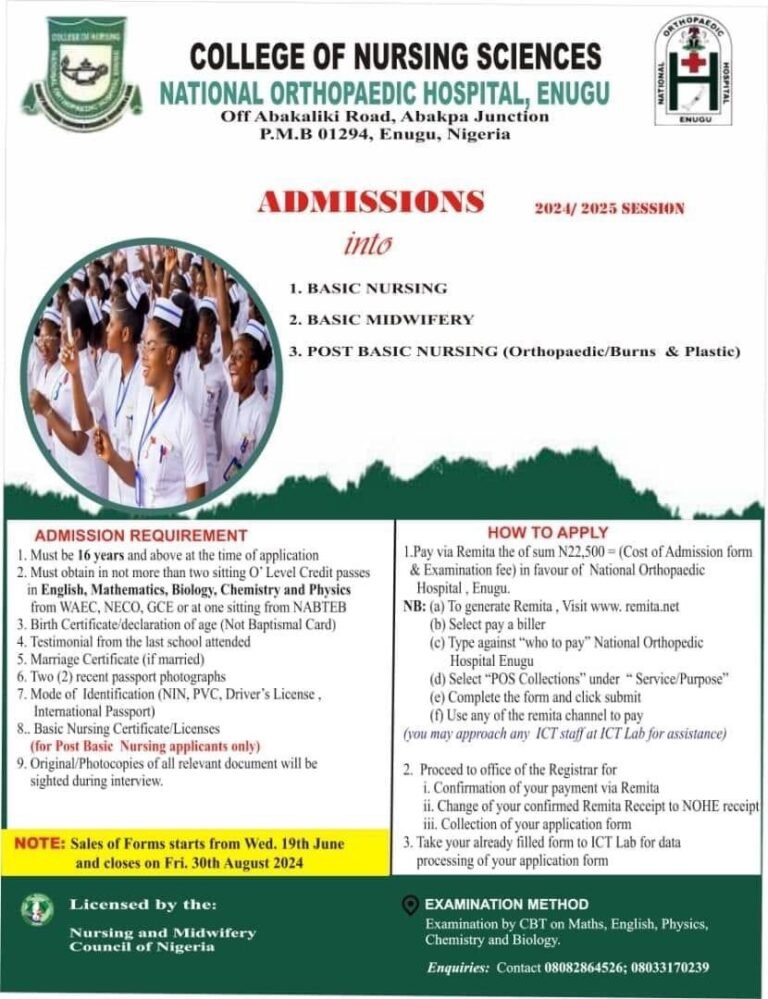
College Of Nursing Sciences, Enugu (National Orthopedic Hospital) 2024/2025 Admission Forms Out

Admission Forms for 2024/2025 academic session into the following programs are out:

  • Basic Nursing
  • Basic Midwifery
  • Post Basic Nursing (Orthopedic/Burns, and Plastic)

Admission Requirements

  • Must be 16 years and above at the time of application.
  • Must obtain in not more than two (2) sittings O’Level Credit Passes in Chemistry, Mathematics, Physics, Biology, and English Language from WAEC, NECO, GCE, or at one sitting from NABTEB.
  • Birth Certification/ Declaration of Age (Not Baptismal Card).
  • Testimonial from the last school attended.
  • Marriage Certificate (if married)
  • Two (2) recent passport photographs
  • Mode of Identification (NIN, PVC, Driver’s License, or International Passport)
  • Basic Nursing Certificate License (for Post Basic Nursing Applicants only)
  • Original/ Photocopies of all relevant documents will be sighted during interviews.

Date For Sales Of Forms

Sales of forms will start on Wednesday, 19th June, and close on 30th August 2024.

How To Apply

  • Pay via Remita the sum of N22,500 (Cost for Admission form and Examination fee) in favor of National Orthopedic Hospital, Enugu
  • NB:
  • To generate Remita, visit www.remita.net
  • Select pay a biller
  • Type against “who to pay” National Orthopedic Hospital, Enugu.
  • Select POS Collections under Services Purpose.
  • Complete the form and click submit.
  • Use any of the remita channels to pay. (you may approach any ICT staff at ICT Lab for assistance).
  • Proceed to the office of the Registrar for
  • Confirmation of your payment via Remita
  • Change your confirmed Remita Receipt to NOHE receipt.
  • Collection of your application form.
  • Take your already filled form to the ICT Lab for data processing of your application form.

Examination Method

Examination by CBT on Mathematics, English Language, Biology, Chemistry, and Physics.

Enquiries

08082864526, 08033170239

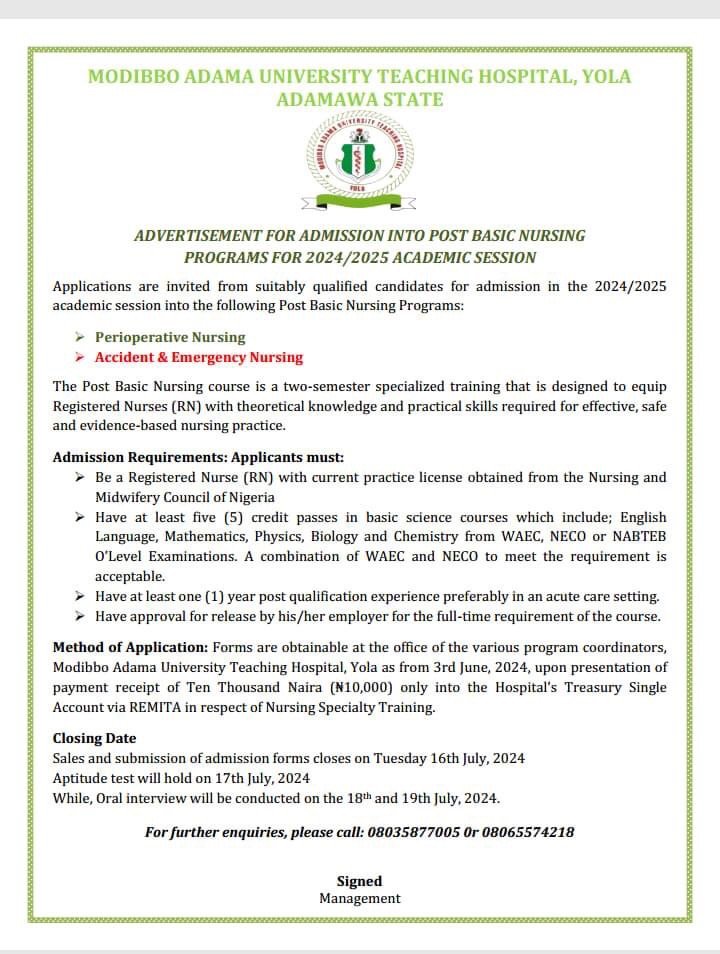
Modibbo Adama University Teaching Hospital, Yola Begins Sales Of 2024/2025 Admission Forms.

1

Advertisement for Admission into Post Basic Nursing Programs for 2024/2025 Academic Session.

Application are invited from suitably qualified candidates for admission in the 2024/2025 academic session into the following Post Basic Nursing Programs:

  • Perioperative Nursing
  • Accident or Emergency Nursing

The Post Basic Nursing is a two-semester specialized training that is designed to equip Registered Nurses (RN) with theoretical knowledge and practical skills required for effective, safe, and evidence- based nursing practice.

Admissions Requirements: Applicant Must:

  • Be a Registered Nurse (RN) with a current practicing license obtained from the Nursing and Midwifery Council of Nigeria.
  • Have at least five (5) credit passes in basic science courses including English Language, Physics, Chemistry, Mathematics, and Biology from NECO, WAEC, or NABTEB O’Level Examination. A combination of WAEC and NECO to meet the requirements is acceptable.
  • Have at least one (1) year post-qualification experience preferably in an acute care setting.
  • Have approval for release by his/her employer for the full-time requirement of the course.

Method Of Application

Forms are obtainable from the office of various program coordinators, Mobiddo Adama University Teaching Hospital, Yola as of 3rd June 2024, upon presentation of payment receipt of Ten Thousand Naira (N10,000) only into the Hospital’s Treasury Single Account via REMITA in respect of Nursing Specialty Training.

Closing Date

Sales and submission of forms close on Tuesday 16th, July 2024. The Aptitude Test will be held on 17th July 2024. While Oral Interviews will be conducted on the 18th and 19th of July, 2024.

For Further Enquiries, Please call: 08035877005 or 08065574218.

Cardio-Respiratory Emergencies/Cardio Pulmonary Arrest

What Is Cardio Pulmonary Arrest

Cardiopulmonary arrest is a sudden cessation of spontaneous effective breathing and circulation, which may lead to death in few minutes.

Causes Of Cardiopulmonary

  • Airway obstruction
  • Cardiac conditions
  • Severe haemorrhage and fluid loss
  • Multiple Injuries
  • Anaphylactic shock
  • Drugs and toxins

Signs and Symptoms Of Cardiopulmonary

  • Unconsciousness
  • Unresponsiveness
  • Not breathing/gasping
  • No Pulse

Management Principles Of Cardiopulmonary

  • Immediate recognition and activation of the emergency.
  • Early cardiopulmonary resuscitation (CPR) with emphasis on chest compression (action must be taken within 4 to 6 minutes) at least 100/min chest compressions.
  • Rapid defibrillation if no response to CPR
  • Effective life support
  • Integrated post-cardiopulmonary arrest care CPR procedures in Adults.

ABC changed to CABD ( Ref AHA 2010 guidelines )

  • C: Circulation
  • Shout for help
  • Start chest compression without delay
    30 chest compression first to precede 2 positive.
  • Pressure ventilations.
  • A: Airways
  • Clear airway immediately
  • Aspirate vomitus and secretions if applicable
  • B: Breathing
  • Ventilation via mask with 100% O2 saturation delivery and bag ventilation if available or mouth-to-mouth resuscitation until intubation is possible.
  • Ensure chest movement and give 2 rescue breaths followed by 30 chest compressions, keep doing this until a portable defibrillator is available or emergency personnel arrives.
  • D: Drugs
  • IV line and maintain circulation
  • IV fluid
  • Inotropic support; Adrenaline 1mg IV every 2-5min or 3mg in endotracheal tube if no IV line
  • Atropine 0.5mg every 3-5min in case of bradycardia (< 40)
  • Sodium bicarbonate 1mEq/kg in case of metabolic acidosis, or prolonged CPR (>15min), and hyperkalemia for known cases of renal failure, crash injury
  • In case of Ventricular Tachycardia and Ventricular; For fibrillation give Amiodarone 300mg IV, if reoccurrence give 150mg IV, alternatively give lidocaine 1.5mg/kg.

Integrated post-cardiopulmonary arrest care

Correct the immediate underlying problem with appropriate management.

Recommendations

Refer to ICU to maintain ventilation
Pacing if indicated.
Any other required management

64 Signs and Symptoms of Some Diseases

  1. PTB – low-grade afternoon fever.
  2. PNEUMONIA – rusty sputum.
  3. ASTHMA – wheezing on expiration.
  4. EMPHYSEMA – barrel chest.
  5. KAWASAKI SYNDROME – strawberry tongue.
  6. PERNICIOUS ANEMIA – red beefy tongue.
  7. DOWN SYNDROME – protruding tongue.
  8. CHOLERA – rice watery stool.
  9. MALARIA – stepladder like fever with chills.
  10. TYPHOID – rose spots in abdomen.
  11. DIPTHERIA – pseudo membrane formation
  12. MEASLES – koplik’s spots.
  13. SLE – butterfly rashes.
  14. LIVER CIRRHOSIS – spider like varices.
  15. LEPROSY – lioning face.
  16. BULIMIA – chipmunk face.
  17. APPENDICITIS – rebound tenderness.
  18. DENGUE – petechiae or (+) Herman’s sign.
  19. MENINGITIS – Kernig’s sign (leg flex then leg pain on extension), Brudzinski sign (neck flex =
    lower leg flex).
  20. TETANY – hypocalcemia (+) Trousseau’s sign/carpopedal spasm; Chvostek sign (facial
    spasm).
  21. TETANUS – risus sardonicus.
  22. PANCREATITIS – Cullen’s sign (ecchymosis of umbilicus); (+) Grey turners spots.
  23. PYLORIC STENOSIS – olive like mass.
  24. PDA – machine like murmur.
  25. ADDISON’S DISEASE – bronze like skin pigmentation.
  26. CUSHING’S SYNDROME – moon face appearance and buffalo hump.
  27. HYPERTHYROIDISM/GRAVE’S DISEASE – exopthalmus.
  28. INTUSSUSCEPTION – sausage shaped mass, Dance Sign (empty portion of RLQ)
  29. MS – Charcot’s Triad (IAN)
  30. MG – descending muscle weakness
  31. Guillain Barre Syndrome – ascending muscle weakness
  32. DVT – Homan’s Sign
  33. CHICKEN POX – Vesicular Rash (central to distal) dew drop on rose petal
  34. ANGINA – Crushing stubbing pain relieved by NTG
  35. MI – Crushing stubbing pain which radiates to left shoulder, neck, arms, unrelieved by NTG
  36. LTB – inspiratory stridor
  37. TEF – 4Cs’ Coughing, Choking, Cyanosis, Continous Drooling
  38. EPIGLOTITIS – 3Ds’ Drooling, Dysphonia, Dysphagia
  39. HODGEKIN’S DSE/LYMPHOMA – painless, progressive enlargement of spleen & lymph tissues,
    Reedstenberg Cells
  40. INFECTIOUS MONONUCLEOSIS – Hallmark: sore throat, cervical lymph adenopathy, fever.
  41. PARKINSON’S – Pill-rolling tremors
  42. FIBRIN HYALIN – Expiratory Grunt
  43. CYSTIC FIBROSIS – Salty skin
  44. DM – polyuria, polydypsia, polyphagia
  45. DKA – Kussmauls breathing (Deep Rapid RR)
  46. BLADDER CA – painless hematuria
  47. BPH – reduced size & force of urine
  48. PEMPHIGUS VULGARIS – Nikolsky’s sign (separation of epidermis caused by rubbing of the
    skin)
  49. RETINAL DETACHMENT – Visual Floaters, flashes of light, curtain vision
  50. GLAUCOMA – Painfull vision loss, tunnel/gun barrel/halo vision (Peripheral Vision Loss)
  51. CATARACT – Painless vision loss, Opacity of the lens, blurring of vision
  52. RETINO BLASTOMA – Cat’s eye reflex (grayish discoloration of pupils)
  53. ACROMEGALY – Coarse facial feature
  54. DUCHENNE’S MUSCULAR DYSTROPHY – Gowers’ sign (use of hands to push one’s self from
    the floor)
  55. GERD – Barretts esophagus (erosion of the lower portion of the esophageal mucosa)
  56. HEPATIC ENCEPHALOPATHY – Flapping tremors
  57. HYDROCEPHALUS – Bossing sign (prominent forehead)
  58. INCREASE ICP – HYPERtension BRADYpnea BRADYcardia (Cushing’s Triad)
  59. SHOCK – HYPOtension TACHYpnea TACHYcardia
  60. MENIERE’S DSE – Vertigo, Tinnitus
  61. CYSTITIS – burning on urination
  62. HYPOCALCEMIA – Chvostek and Trosseaus sign
  63. ULCERATIVE COLITIS – recurrent bloody diarrhea
  64. LYME’S DSE – Bull’s eye rash
    Ottorhea s/s of basilar fracture

Public Health Specialist (Epidemiology) at World Health Organization (WHO)

0

Contract Duration (Years, Months, Days): 1

Job Posting

Jun 8, 2024, 7:34:16 AM

Closing Date

Jun 29, 2024, 10:59:00 PM

Primary Location

Nigeria-Abuja

Organization

World Health Organization and Other Entities

Schedule

Full-time

IMPORTANT NOTICE:

Please note that the deadline for receipt of applications indicated above reflects your personal device’s system settings.

OBJECTIVES OF THE PROGRAMME:

The incumbent will enhance national capacity in overall disease prevention and control by collaborating on the development and implementation of national, public health Programmes and strategies on surveillance and response which may include emerging and re-emerging infectious diseases. This may also serve to strengthen early detection, verification and rapid response to epidemics and other public health events of national or international concern.

DESCRIPTION OF DUTIES

The incumbent will perform all, or part of the following, and other related responsibilities as required by the needs of the office.1.

Advance coordination with all technical focal points at regional and headquarters levels, under the guidance of the head of the WHO country office.2.

Provide authoritative advice to national public health authorities and lead the epidemiological work of the country office that under pins policy formulation.

Support relevant teams on building core capacities for surveillance, early detection, verification and rapid response to epidemics and other public health events of international concern, as required in the International Health Regulations (IHR) 2005.

Ensure that the WHO Country Office has access to all relevant existing country-specific health-related data.

This includes national and subnational datasets, such as demographics of populations affected by specific diseases (relevant age,gender, etc.) and time trends.

Analyze such data sets to provide additional insights on the country’s health context and epidemiological situation.

Serve as focalperson for all internal and external requests related to country-specific data. As needed, ensure government agreement for the use and dissemination of such data.

Assist the government and relevant institutions on the enhancement of national capacities in epidemic and disease-trends’ forecasting and detection systems, including epidemiology and laboratory surveillance for monitoring and evaluating the core surveillance and real-time analysis of outbreak intelligence data.

Lead and coordinate the development of training courses for public health professionals on epidemiological surveillance, outbreak investigation, and/or the improvement of related data management.

Oversee the WHO Office’s support to the government in conducting field investigations of public health events. when required by the specific country or health situation.

Collaborate with Health Emergency teams to promote WHO’s position and successfully influence national health authorities to develop infection prevention and control programmes in health care facilities, including (where and when required) focusing on preparedness and response to epidemics and pandemics.

Participate, as needed, in risk assessments for unusual health events.

Collaborate with relevant authorities on the development and maintenance of a national system or comprehensive data collection and trend analysis of public health events.

Play a lead role in the analysis, interpretation, and knowledge building of surveillance data (including virological data) through WHO and peer-reviewed publications and media.

Encourage collaboration and develop innovative advocacy initiatives and project proposals for joint action and resource mobilization to augment national, operational responses to public health events.

Act as the mainliais on between government and WHO (all levels) on country-specific data gathering and dissemination of WHO-generated data and data analysis.

Perform other activities as required by WHO Representative.

REQUIRED QUALIFICATIONSEducationEssential: Advanced university degree (Master’s level) in epidemiology, public health, medical or other studies in a field directly related to the position.Post-graduate training in epidemiology (EPIET) or similar programme
Desirable: Specialized training in public health would be an asset with a focus on monitoring impact of public health interventions
ExperienceEssential: A minimum of seven (7) yearsof work experience relevant to the position (in epidemiology including developing and/or implementing Programmes, policies, and guidelines as well as monitoring and evaluation of diseases and public health issues), with some of it obtained in an international context. Part of this must have been in a developing country context
Desirable: Experience in public-health responses in complex emergency and humanitarian crisis situations Experience in WHO or within the UN system with an understanding of its mandate, goals, and procedures
SkillsDemonstrated knowledge and professional skills in the development and implementation of public health surveillance systems.Seasoned expertise in the collection, analysis, and interpretation of epidemiological and event-based surveillance data. Strong ability to process, analyse and interpret epidemiological and event-based surveillance data. Expertise in providing technical support/guidance for a rapid, public-health response topublic-health events.Experience in data analysis and interpretation related to epidemics/pandemics.Knowledge of the communicable and non-communicable disease profile of the country. Demonstrated training skills (developing and conducting training).Ability to lead and coordinate multidisciplinary teams, projects, and programmes. Demonstrated skills to develop public-health guidelines
WHO CompetenciesTeamwork
Respecting and promoting individual and cultural differences
Communication
Building and promoting partnerships across the organization and beyond
Producing results
Use of Language Skills

Essential: Expert knowledge of English.
Desirable:

REMUNERATION

WHO salaries for staff in the Professional category are calculated in US dollars. The remuneration for the above position comprises an annual base salary starting at USD 77,326 (subject to mandatory deductions for pension contributions and health insurance, as applicable), a variable post adjustment, which reflects the cost of living in a particular duty station, and currently amounts to USD 3873 per month for the duty station indicated above. Other benefits include 30 days of annual leave, allowances for dependent family members, home leave, and an education grant for dependent children.
ADDITIONAL INFORMATION

  • This vacancy notice may be used to fill other similar positions at the same grade level
  • Only candidates under serious consideration will be contacted.
  • A written test and/or an asynchronous video assessment may be used as a form of screening.
  • In the event that your candidature is retained for an interview, you will be required to provide, in advance, a scanned copy of the degree(s)/diploma(s)/certificate(s) required for this position. WHO only considers higher educational qualifications obtained from an institution accredited/recognized in the World Higher Education Database (WHED), a list updated by the International Association of Universities (IAU)/United Nations Educational, Scientific and Cultural Organization (UNESCO).
  • According to article 101, paragraph 3, of the Charter of the United Nations, the paramount consideration in the employment of the staff is the necessity of securing the highest standards of efficiency, competence, and integrity. Due regard will be paid to the importance of recruiting the staff on as wide a geographical basis as possible.
  • Any appointment/extension of appointment is subject to WHO Staff Regulations, Staff Rules and Manual.
  • Staff members in other duty stations are encouraged to apply.
  • The WHO is committed to creating a diverse and inclusive environment of mutual respect. The WHO recruits and employs staff regardless of disability status, sex, gender identity, sexual orientation, language, race, marital status, religious, cultural, ethnic and socio-economic backgrounds, or any other personal characteristics. 
  • The WHO is committed to achieving gender parity and geographical diversity in its staff. Women, persons with disabilities, and nationals of unrepresented and underrepresented.
  • Persons with disabilities can request reasonable accommodations to enable participation in the recruitment process.
  • An impeccable record for integrity and professional ethical standards is essential. WHO prides itself on a workforce that adheres to the highest ethical and professional standards and that is committed to put the WHO Valuer into practice.
  • WHO has zero tolerance towards sexual exploitation and abuse (SEA), sexual harassment and other types of abusive conduct (i.e., discrimination, abuse of authority and harassment). All members of the WHO workforce have a role to play in promoting a safe and respectful workplace and should report to WHO any actual or suspected cases of SEA, sexual harassment and other types of abusive conduct. To ensure that individuals with a substantiated history of SEA, sexual harassment or other types of abusive conduct are not hired by the Organization, WHO will conduct a background verification of final candidates.
  • Mobility is a condition of international professional employment with WHO and an underlying premise of the international civil service. Candidates appointed to an international post with WHO are subject to mobility and may be assigned to any activity or duty station of the Organization throughout the world.
  • WHO also offers wide range of benefits to staff, including parental leave and attractive flexible work arrangements to help promote a healthy work-life balance and to allow all staff members to express and develop their talents fully.
  • The statutory retirement age for staff appointments is 65 years. For external applicants, only those who are expected to complete the term of appointment will normally be considered.
  • Please note that WHO’s contracts are conditional on members of the workforce confirming that they are vaccinated as required by WHO before undertaking a WHO assignment, except where a medical condition does not allow such vaccination, as certified by the WHO Staff Health and Wellbeing Services (SHW). The successful candidate will be asked to provide relevant evidence related to this condition. A copy of the updated vaccination card must be shared with WHO medical service in the medical clearance process. Please note that certain countries require proof of specific vaccinations for entry or exit. For example, official proof /certification of yellow fever vaccination is required to enter many countries. Country-specific vaccine recommendations can be found on the WHO international travel and Staff Health and Wellbeing website.
  • WHO also offers wide range of benefits to staff, including parental leave and attractive flexible work arrangements to help promote a healthy work-life balance and to allow all staff members to express and develop their talents fully.
  • The statutory retirement age for staff appointments is 65 years. For external applicants, only those who are expected to complete the term of appointment will normally be considered.
  • Please note that WHO’s contracts are conditional on members of the workforce confirming that they are vaccinated as required by WHO before undertaking a WHO assignment, except where a medical condition does not allow such vaccination, as certified by the WHO Staff Health and Wellbeing Services (SHW). The successful candidate will be asked to provide relevant evidence related to this condition. A copy of the updated vaccination card must be shared with WHO medical service in the medical clearance process. Please note that certain countries require proof of specific vaccinations for entry or exit. For example, official proof /certification of yellow fever vaccination is required to enter many countries. Country-specific vaccine recommendations can be found on the WHO international travel and Staff Health and Wellbeing website.
  • WHO has a smoke-free environment and does not recruit smokers or users of any form of tobacco.
  • In case the website does not display properly, please retry by: (i) checking that you have the latest version of the browser installed (Chrome, Edge or Firefox); (ii) clearing your browser history and opening the site in a new browser (not a new tab within the same browser); or (iii) retry accessing the website using Mozilla Firefox browser or using another device.

Click here to apply

The Roles Of Nurses In Asthmatic Attack, Cariogenic, And Hypovolemic Shock

What Is Asthma Attack

It is a deterioration of the baseline asthma control leading to acute wheeze, shortness of breath and dyspnoea.

What Causes Asthma Attack

  • Upper respiratory tract infections (especially viral).
  • Shortage of asthma drugs.
  • Exposure to triggers (cold, dust, Smoke, etc)
  • Stress

Signs and Symptoms Of Asthma Attack

  • Wheezing
  • Dyspnoea
  • Mucus secretions
  • Cough
  • Chest tightness
  • Quiet chest and decreased oxygen saturation (severe signs)

Complications Of Asthma Attack

  • Pneumothorax
    Status asthmatics: an intractable asthmatic crisis with severe
    bronchospasm. It is managed by first evaluating ABC, with
    100% oxygen, salbutamol 0.5mg/hr IV, hydrocortisone 200mg
    IV bolus; if not responding give adrenaline 0.1mg/ IV bolus and
    magnesium sulphate 2g IV over 20min; If still not responding
    consider intubation and mechanical ventilation under sedation
    with ketamine12mg/kg IV
  • Investigations
    FBC
    Blood gases
    CXR
  • Do not give sedatives or aminophylline. Give anticholinergic such as ipratropium bromide in case of increased respiratory secretions. Monitor parameters indicating severity.

How To Treat Asthma Attack


Start treatment immediately

  • Semi-sitting position O2 to keep saturation above 90%
  • Short acting Beta 2 agonist nebulisation ( eg salbutamol 5 mg in 5 ml of normal saline over 10 minutes repeated ½ hour later).
  • Hydrocortisone 100 mg IV every 6 hrs
    Assess the need of ventilation according to the response to the therapy
  • Avoidance of the triggering agent if known.
  • Patient education on medication and other strategies

Recommendations

Refer to tertiary level all cases with failure of above therapy of
acute asthma, development of status asthmatics. Also, contact your health provider.

Shock

Definition Of Shock

Shock is a syndrome characterized by decreased perfusion
of the tissues in the body which if prolonged leads to irreversible multiple organ failure.

Classification Of Shock

  • Hypovolemic
  • Cardiogenic
  • Septic
  • Anaphylactic

Complications Of Shock

  • Renal Failure
  • Hepatic Failure
  • Metabolic Acidosis
  • Coma
  • Death

Hypovolemic Shock

Definition Of Hypovolemic Shock

This is due to loss of intravascular fluid volume (blood and/
or fluid loss).

What Is Hypovolemic Shock

  • Excessive haemorrhage ( e.g. trauma, internal bleeding, such as in the gastrointestinal tract)
  • Excessive fluid loss (eg. diarrhoea, vomiting, severe burns)
  • Intestinal obstruction (mechanical or paralytic ileus)

Symptoms Of Hypovolemic Shock

  • Fainting
  • Palpitations
  • Sweating (cold sweat)
  • Restlessness
  • Clouding of consciousness

Signs Of Hypovolemic Shock

  • Pallor
  • Cold extremities
  • Tachycardia
  • Hypotension: Systolic BP <90 mmHg
  • Temperature is subnormal (less than 35°C)

Investigations

  • FBC
  • Serum urea , creatinine and electrolytes
  • Blood sugar
  • Group and crossmatch blood
  • Blood gas analysis if possible
  • Blood cultures

Management

  • Non pharmaceutic
  • Control obvious bleeding with direct pressur
  • Insert one or two large bore IV catheters for rapid IV
    infusion
  • Urinary catheter
    Initial volume resuscitation
  • Raise drip stand or squeeze bag to increase infusion rate:
    Give colloids and/or crystalloids e.g. Sodium Chloride 0.9%.
    Aim to give 70 ml/kg body weight
  • Monitor blood pressure, pulse and clinical response: Target a mean arterial pressure ≥ 65mmHg and urine output > 30ml/hr
  • Most patients will respond to the initial fluid bolus
  • If they respond initially and subsequently deteriorate, there
    may be an ongoing occult haemorrhage
  • Consider blood transfusion (if haemorrhage is >25% of
    total blood volume)
  • Fluid should be given quickly and slowed only when BP
    rises and urine flow is adequate
  • Give Oxygen 6 L/min via nasal or facial masks if indicated
  • Continue to monitor BP, pulse and urine output.

Recommendations

  • Refer to ICU if needed.
  • Refer for surgical intervention if indicated.
  • Consult your health provider.

Cariogenic Shock

What Is Cariogenic Shock

This is advanced cardiac failure with inadequate peripheral
tissue perfusion.

Hemodynamic criteria are :

  • Sustained hypotension for at least 30min( SBP 90mmHg)
  • Low cardiac index( <2.2 l/min/m2)
  • Elevated capillary wedge pressure( >15mmHg)

What Causes Cariogenic Shock

  • Valvular Heart Disease
  • Myocardial Infarction (Right or Left)
  • Pericardial Tamponade
    Myocarditis.
  • Hypertensive Obstructive Cardiomyopathy.
  • End stage cardiomyopathy.
  • Myocardial contusion.

Signs and Symptoms Of Cariogenic Shock

  • BP less than 90mmHg systolic Weak or undetectable pulse
  • Cold extremities
  • Peripheral cyanosis
  • Poor urine output
  • Pulmonary signs (Crepitations, Dyspnoea)
  • Raised JVP

Investigations

  • FBC
  • Serum urea, creatinine and electrolytes
  • Cardiac Enzymes (LDH, Troponin, Creatinine Kinase)
    CXR
  • ECG
    Echocardiography

Management

Non-Pharmaceutical

  • Oxygen to keep saturation >90%
  • Large bore IV cannula
  • IV fluid bolus (if predominant right heart failure).
  • Urinary Catheter

Pharmaceutical

  • Diuretics if predominant left heart failure and pulmonary
    congestion (avoid otherwise): Frusemide eg 40mg IV stat
    and monitor response.
  • Management of underlying cause
    →Ischaemia: Aspirin 100mg po stat, Morphine 210mg IV/IM for pain,
    Glyceryl Trinitrite (if BP permits, contraindicated in hypotension), Thrombilysis
    →For Pericardial Tamponade: pericardiocentesis

Recommendation

Refer to ICU or a tertiary centre if the patients with cardiogenic shock are not responding to above measures.