ND/HND Nursing Programme for 2024/2025 academic session.
Admission Requirements
Evidence of choice of Institution or Evidence of change of Institution.
UTME Result
O’Level Results
Two (2) recent passport sized photographs, preferably colored white background.
Evidence of birth certificate from National Population Commission, or Age Declaration.
Post UTME Documentation
This is to inform all the prospective candidates for admission into College of Nursing, Amichi, for National Diploma in Nursing Programme that the documentation for Post UTME screening commences as follows:
Date For Documentation Exercise
6th of June to 31st of July, 2024
Venue
Admission Office, College of Nursing, Amichi.
Time
9 am to 3 pm on all working days (Except Mondays Sit-At-Home)
Note:
College of Nursing Sciences, Amichi does not have any WhatsApp group created by the School management or staff of ND NURSING admission.
The process of documentation in this College is not online.
It doesn’t involve any form of online payment from our website.
Malaria Consortium Nigeria is committed to tackling the large number of malaria cases and deaths in the country. Working in partnership with the Ministry of Health and other partners, we lead and support three major malaria control initiatives in the country: Support to the National Malaria Control Programme (SuNMaP); NetWorks and MAPS. Our areas of focus include: Technical support for malaria control Capacity building, harmonisation and training of health workers Heath systems strengthening Behaviour Change Communications and community outreach activities Operational research, policy and advocacy
Job Type: Full Time
Qualification: BA/BSc/HND
Experience: 5 years
Location: Kaduna
Job Field: NGO/Non-Profit , Project Management
Job purpose
The job purpose is to work with State Programme Manager (SPM) to effectively manage project activities and resources. top provide leadership and stewardship to the project team and maintain collaborative links with the project’s key stakeholders at the LGA level.
Scope of work
The project officer will support the SPM in the implementation of the MDA-AZM project across the state. S/he will work with LGA Field Assistants and will be responsible for liaising with the focal persons at the Local Government Level.
Key working relationships
The PO would be line managed by the SPM and would work with the LGA Field Assistants in-charge of the assigned LGAs (presumably within a specific senatorial zone of a state). S/he would also maintain relationships with the country office departments, including Finance and Logistics. Key external relationships would be with staff at the LGA and State Malaria Elimination Programme (SMEP), LGA health staff and leading community members and gatekeepers. S/he would lead micro-planning, training and coordination, through drug administration and supportive supervision, to reporting of activities at the LGA level. S/he would maintain close communication with stakeholders and influential persons in the assigned LGAs through the agreed frameworks.
Key accountabilities
Programme Management (70%)
Support the SPM and the state management team to lead activities for smooth programme management in the assigned LGAs in the following areas:
Liaise and work with the SMC project team in the assigned LGAs;
Be conversant with and guided by Malaria Consortium, policies, guidelines and the SMC Handbook towards the delivery of MDA-AZM in assigned LGAs;
Planning (microplanning, selection of implementers at the local levels, training, database finalization, last mile distribution, MDA-AZM and reverse logistics);
Engagement of stakeholders including government, communities and beneficiaries;
Implementation (MDA-AZM) including QA and innovations, including the use of technology;
General management including security, HR including line management, risk management, work planning and budgeting, VFM, optimization of grant, etc.;
Risk Free operations including ensuring that all staff comply with MC values and start-to-finish (SFG) policies; and
Coordination with other levels of government and internally, all MC functions.
Technical (20%)
Support M&E activities, including reporting of MDA-AZM and lot quality assurance sampling (LQAS); and
Support programme review including end of cycle (EoC) reviews, end of round (EoR) reviews and EoR coverage survey.
Representations & Knowledge Management (10%)
Lesson identification and use including adaptive management;
Harmonization with other partners; and
Representation especially at the LGA levels.
Person specification
Qualifications and experience:
Essential
Training in Nursing or Public Health;
Five years’ experience of working in the Public Health sector;
Experience in programme management at the LGA/state level;
Excellent project planning, management and monitoring & evaluation skills.
Experience managing project budgets;
Experience in using digital data collection tools in SMC campaigns and other health programmes;
Some practical experience in Health Information and Disease Surveillance Systems, interoperability, and international standards; open Global Health Information System software and open data sources, such as, but not limited to, DHIS2, ODK, KoboCollect;
Experience working at the LGA and community levels;
Experience working on campaign style interventions (delivery of integrated interventions or social mobilization and SMC would be an added advantage).
Work-based skills and competencies:
Essential
Good understanding of the Nigeria health system;
Understanding of communication for behaviour change and social mobilisation;
Team player and demonstrated ability to work within a team as well as individually;
Ability to travel to LGAs outside of state capital at least 80% of the time;
Ability to perform under pressure;
Excellent communication skills in English and the dominant local language in assigned state;
Evidence of being resident in state of assignment.
Sales of admission forms into ND/HND Nursing and other Nursing Programme is currently ongoing at the College Registry.
Eligibility
Prospective candidates must have sat and obtained five (5) credits pass in English Language, Mathematics, Physics, Biology, and Chemistry in not more than two (2) sittings in WAEC, GCE. SSCE, NECO, or NABTEB.
Candidates for ND/HND Programme must have sat for the 2024 UTME JAMB and secured at least 150 scores.
Method of Application
Forms are obtained from the office of the College registrar on payment of the sum of N20,000 and N10,000 for handling charges both which must be receipted for.
Candidates must come along with two (2) recent colored passport photographs.
Closing date for the purchase and submission of completed forms is 12th August, 2024
Post UTME test and oral interview is on the 31st August, 2024 in the college compound.
Time: 09:00 am.
NOTE:
No purchase of forms or any other admission process is done online.
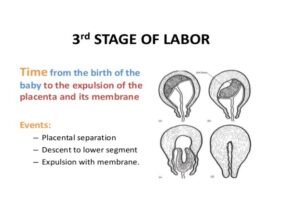
The uterus reduces in size 2.5cm below the umbilicus, or 15cm above the symphysis pubis after the expulsion of the fetus. The contraction and retraction of the uterine muscles continues. The placental site is reduced to half. Since the placenta is inelastic, it does not contract, so it detaches from the shrinking uterine wall. The placenta is pushed further to the lower.
This is accumulated blood from the separated placenta. With the next contraction the placenta is pushed into the vagina and expelled.
You will know that the placenta has separated and has been expelled from the upper uterine segment into the lower segment or into the vagina when you have noted:
Elongation of the cord which does not recede on pressing at the symphysis pubis
A gush of blood.
The uterus contracts like a cricket ball.
The placenta is expelled either with maternal side exposed, known as the Mathew-Duncan method or the foetal side exposed known as the Shultz Method.
Control of Bleeding After Delivery
Steps should be taken to ensure the control of bleeding:
The uterine muscle’s contraction and retraction causes the placental site to reduce into half. Criss-cross fibres control bleeding by compressing the blood vessels. These fibresare also known as ‘living ligatures’
Clotting of blood takes place in the sinuses sealing the bleeding points a few hours later when uterine contractions are less vigorous.
The time interval between the delivery of the baby and delivery of the placenta is a dangerous period, in which one of the greatest complications of pregnancy and labour can occur.
This complication is excessive bleeding or postpartum haemorrhage (PPH). You should never leave the mother alone even for a short while during this stage.
The third stage of labour can be managed either passively or actively.
The Passive or Natural Method of Managing the Third Stage of Labour
The passive or natural method occurs naturally, that is without any interference. For example, in a normal delivery, if oxytoxic drugs are not used, the uterus generally remains inactive for a few minutes after the delivery of the baby, after which regular contractions then begin again.
Physiology of the third stage takes place, the placenta is expelled and bleeding is controlled.
Giving Oxytocic Drugs
Oxytocin, ergometrine or syntometrine stimulate uterine contraction.
Ergometrine 0.5mg given IM causes a uterine contraction to occur five to seven minutes after the injection. Given intravenously it acts within 45 seconds.
Syntometrine is a mixture of oxytocin and ergometrine 0.5ml given IM acts within two to three minutes.
Usually sytrometrine is given with the delivery of the anterior shoulder while ergometrine is given at the crowning of the head.
Controlled Cord Traction
The uterus must be firmly contracted before this method can be used. It is not necessary to wait for signs of placenta separation.
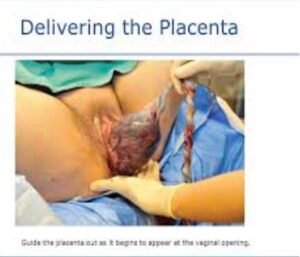
Place the left hand above the symphyis pubis, push the uterus upwards and backwards with the right hand and pull the cord downwards and outwards.
Apply traction steadily without jerking When the placenta is visible at the vulva, direct the cord upwards.
The placenta will follow the curve of the birth canal. Receive it with both hands and rotate the placenta. This will twist the membranes. You can then deliver the membranes with up side movements, which enable them to be drawn out without breaking.
Maternal Effort
This method is not commonly used. When the placenta has separated and descended, the palm is placed downwards on the mother’s abdomen to provide a backup that the mother can push against.
During a contraction, the mother should be asked to push down. The placenta will be pushed out of the vagina. This method is useful in the event of a macerated birth.
Do not apply downward fundal pressure while doing cord traction as this can lead to inversion of the uterus.
The other method that can be used to deliver the placenta is the fundal pressure method.
Fundal Pressure
This method should be used in case of a macerated or pre-term baby as the strength of the cord is reduced. You should wait for the following signs of placental separation:
The fundus feels hard like a cricket ball.
There is a gush of blood due to placenta separation.
The cord lengthens and doesn’t recede with pressure on the symphysis pubis.
Procedure
Make sure the bladder is empty.
Instruct the mother to breathe through an open mouth slowly and quietly.
When there is a contraction, grasp the uterus with your left hand fingers behind the uterus.
Thumb in the anterior surface. Apply pressure to the pelvic inlet in downward and backward direction.
Receive the placenta with both hands.
If the membranes do not slip out, turn the placenta around and deliver the membranes slowly with an upward movement.
Rub the uterus and expel the clots. Once the placenta is out, you will need to examine the birth canal.
Explain to the mother that you need to check if she has any tears, warn her it will be a bit painful but the worst part has passed, you will be very gentle and quick and that she needs to cooperate
Change the gloves, roll gauze over pointing and middle fingers of the right hand
Insert middle fingers of left hand facing upwards pushing the upper vaginal wall
With the right hand press down the lower vaginal wall exposing the cervix.
Check for any tears with the two fingers of your right hand, mop both sides of the vaginal wall, finish with the fourchette
Reassure the mother in case there is any tear for suturing
Cover the perineum with the folded pad into a half
Wipe the buttocks from the fourchette towards the rectum cover the perineum completely.
Collect any blood loss from the bed
Change the bed linen with the help of an assistant
In case of episiotomy or a tear, scrub your hands while your assistant is setting a sterile suturing pack and repair the tear.
Ask the mother to lie on her back with her legs crossed on each other
Ask the assistant to hand over the baby to the mother.
Leave the mother to rest while you go to examine the placenta.
The Fourth Stage of Labour
The fourth stage starts after the delivery of the placenta and lasts for one hour. The nurse or midwife should observe the mother for blood loss, monitor vital signs, reassure her and let the mother hold the baby.
The nurse should also record notes in the patients file, fill in the baby notification form and after the hour is over escort the mother to the maternity unit.
Examination of the Baby
A thorough physical examination is done one hour after birth with the aim of assessing maturity and excluding obvious congenital abnormalities and injuries at birth.
In order to carry out this examination, you need to have with you the following equipment in a tray:
Tape measure
Second hand watch
Gloves
Weighing scale
Clinical thermometer
Lubricant
Swabs
Stethoscope
Vital signs – heart rate (120-160/min), respiration (20-60 average 44/min), and temperature (36-37 degrees centigrade).
Head – Check the shape to see if there is excessive moulding, caput succedaneum or depressed fractures to exclude head injury, microcephalus or hydrocephalus. Take head circumference (Approximately 33-37 cm).
Ears – Check position. If they are low set, this may indicate Down’s syndrome or Mongolism. Check for any missing lobes or cartilage.
Eyes – Check for presence of eyeball injuries, discharge or jaundice.
Mouth – Check for harelip, cleft palate, tongue-tie or false teeth, septic spots, thrush, cysts.
Nostrils – Check for patency with no polyps or flaring.
Neck – Check for congenital goitre or enlarged glands.
Upper limbs – Check for equality, free movement, fractures, webbed fingers, extra digits and any bony tissues. Extra digits can be ligated with silk and will fall off (with the parents permission). Check for Erb’s palsy.
Chest – Check for continuity of sternum and the shape of rib-cage, respiratory rate, enlarged breast or absence of breast tissue.
Abdomen – Should be intact and firm, check for umbilical hernia and exomphalus(protrusion of abdominal organs through a defect in the anterior wall). Abdominal distension is present in hydrops foetalis. Check for blood oozing from the cord and clamp again if necessary (cord shrivels within 24 hours, falls off 6-10 days).
External genitalia – Confirm the sex of the baby to rule out pseudohaemophrodism or intersexes. In males check for undescendedtestes, hypo/hyperspadias and phimosis. In females, check for bleeding from urethral and vaginal orifice. Vaginal bleeding may be due to excessive hormones from the mother.
Neurological Assessment
This entails the checking of reflexes, which deal with the function of the baby’s nervous system as well as physical and behavioral assessments. At the beginning of the examination, observe the baby’s movements.
These movements involve all extremities and should be random and symmetrical but never stereotyped. Sometimes jitteriness or tremors will be noted. The first time you notice these movements they may look like fits. To determine the difference between the two, hold the affected limb. If it is the former the tremors should stop.
Moro Reflex
Support the baby’s head and body in supine position about a centimeter from the cot. Allow the head to drop back. Look at the baby’s response. The baby throws out his arms extending the elbows and fingers with embracing movements of the arms. What is the significance of the Moro reflex?
The Moro reflex is symmetrical in a normal baby at birth and disappears after three months.
It is incomplete in the pre-term baby and absent in the baby with inter cranial drainage. If brain damage is not severe it returns after three to four days. If it disappears some hours after birth, you should then suspect increasing cerebral oedema or slow intra cranial haemorrhage.
Tonic Neck Reflex
A fencing position is assumed, that is, the baby lies on the back, head rotated to one side with one arm and leg partially or completely extended. The opposite arm and leg are flexed. This is a manifestation of the immaturity of the newborn’s nervous system.
Rooting Reflex
To test for the rooting reflex, gently touch the corner of the baby’s mouth with clean fingers.
The baby will open his mouth turning towards the stimulus in anticipation of the mother’s nipple. To check for sucking reflex place a clean finger in the baby’s mouth noting the sucking strength. The sucking reflex is poor in pre-term babies.
Stepping Reflex
The stepping or dancing reflex is present at birth but disappears soon after. Once this reflex diminishes, the infant does not attempt a stepping motion until he/she starts to walk. Hold the infant up, with the feet touching a surface. The infant will attempt to make some steps or pressing movements.
Grasp Reflex
It is amusing to learn that a newborn baby can grasp. At birth, the grasping reflex of both hands and feet is present. The infant will grasp any object you place in their hand, and then let it go.
They are able to hold on to a finger so securely, that you can lift them to a standing position. Stroking the soles of the feet causes the toes to turn downwards trying to grasp. By applying traction to the baby’s wrists raise them to a sitting position. A full term infant will offer a pre-term does not resist the pull.
Protective Reflex
Other reflexes include protective reflexes such
as:
The blinking reflex, which protects the eyes from bright light.
Sneezing and coughing reflexes used to infant’s throat.
The yawn reflex, which draws additional oxygen.
Cry reflex, which helps to withdraw from painful stimuli.
Once this examination is completed, the baby can be placed on the cot for transfer to the nursery or given to the mother.
After completing the delivery of the baby, you should transfer the mother to the postnatal ward where she will rest.
Changes that take place in a woman who has just delivered during puerperium
The puerperium period covers six to eight weeks following delivery or abortion and is characterized by:
General organs return to their pregravida state
Initiation of lactation..
Recuperation.
The Psychology of the Mother During Puerperium
During the puerperium the mother is subjected to emotional turmoil and you must be supportive and observant.
She should be allowed to cuddle her baby and express her love as she wishes. This maternal instinct is at times delayed.
The midwife should be kind, patient, and compassionate towards the mother and give her the necessary education concerning her and the baby.
Each mother should be taken as an individual based on her maternal experience, educational background, maturity and parity.
Mothers should be given all the information necessary to ensure they know how to care for their babies.
Rooming is the term given when a hospital plans for the mother to stay with the baby for most of the 24 hours in a day.
It is highly recommended because it has been seen to have great psychological advantages for both mother and baby.
Bonding commences immediately and demand breast-feeding can be successfully practiced.
Most baby-friendly hospitals in this country encourage rooming in.
Postpartum Tears or Fourth Day Blues
This condition is characterized by mild depression and mood swings due to a Temporary endocrine hormonal imbalance following childbirth.
It occurs in fifty percent of post-natal mothers on around the fourth day.
A midwife should try to prevent the ‘blues’ by educating the mother during the pre-natal period on how to take care of herself and the baby to build up her confidence.
Admission is opened for 2024/2025 academic session for ND Nursing and Basic Midwifery.
Notice is hereby given to prospective candidates and the general public that forms for Post UTME Screening for the National Diploma (ND) and Basic Programmes of the College of Nursing Sciences, Calabar is now available at the College Registry.
Admission Procedure
Payment of the sum of Twenty-five Thousand (N25,000) only into the CRS School of Nursing Account domiciled in First Bank with the Account No. 2031807641.
Evidence of payment tendered at the College Bursary and the payment of N10,000 cash as handling charges.
Receipts from Bursary presented at Registry Department for Form(s).
Admission Requirements
Applicants must possess five (5) credits in English Language, Mathematics, Physics, Biology, and Chemistry obtained in either WAEC, NECO or NABTEB in not more than two (2) sittings.
Should possess 2024 JAMB results with 150 score and above reflecting the College of Nursing Sciences , Calabar or any other institution thereof.
Credentials to include First School Leaving Certificate, Birth Certificate/Age Declaration, LGA of Origin, and Two (2) passport sized photographs.
Deadline
Closing date for the sales of forms is 1st August, 2024.
Screening Venue
College Premises, Opposite the Court, Moore Road, Calabar.
Screening Date
The screening date is on Tuesday 20th to Thursday 23rd August, 2024.
The Women and Children Health Empowerment Foundation (WACHEF), is a Non-Governmental Organization (NGO) registered to practice in Nigeria. The NGO works in partnership with public, private and other non-government organizations to promote accountability, good governance and contribute in achieving equitable, sustainable and quality healthcareand social services delivery among the poor and vulnerable population, especially women and childrenin Nigeria. WACHEF was registered with Taraba State Government in 2001 and with the Corporate Affairs Commission (CAC) of Nigeria in August 2005 with registration number CAC/IT/No 19194.
The purpose of this position is to provide technical guidance to the organization in the implementation of technical program activities for community-based HIV Care and Support in the Program.
Under the supervision/direction of the program Manager, s/he will collaborate closely with the team to roll out and implement an integrated and holistic community-based response to HIV / AIDS towards scaling up access to HIV prevention and care services for vulnerable children and their caregivers.
General Function
The Prevention, Care & Support specialist will be responsible for working closely with the ICHSSA4 HIV prevention care & Support Programme Management specialist as well other ICHSSA 4 technical team to achieve the strategic objectives of the program
Focusing primarily on HIV prevention, Care & Support but also supporting cross-cutting themes and integration efforts across the project with other areas of OVC programming including Household Economic Strengthening, gender, and Nutrition.
Major Responsibilities
S/he will provide technical support primarily in the area of Community based HIV Care & Support for project beneficiaries affected by HIV.
S/he will be responsible for strengthening the linkages between the community-based care activities and health facilities providing HIV treatment towards ensuring a continuum of care.
S/he will also support the strengthening of the capacity of implementing CSOs in the area of HIV prevention awareness creation, community mobilization for HIV counselling and testing, PMTCT and Early Infant Diagnosis (EID), improving referral and counter-referral systems between communities and facilities. In addition,
s/he will support the implementation of evidence-based interventions aimed at addressing HIV risk behaviors, HIV transmission, and gender-based violence
Specific Responsibilities:
Link all identified HIV positive beneficiaries to HIV treatment care and support service
Administer quarterly HIV care and support, Nutrition and PHDP checklist as applicable to ICHSSA 4 beneficiaries and refer appropriately.
Development of “care plan” for vulnerable household.
Completion of referral forms in line with ART and other services in accordance with identified/required services by the beneficiary
Provide support to community case workers and other stakeholders.
Refer and provide escort of ICHSSA4 beneficiaries to HIV service points for uptake of HIV related services
Mobilize ICHSSA 4 beneficiaries for community outreaches for HTC and conduct follow up visits to HIV positive beneficiaries for continuous adherence support.
Participate in monthly LGA level referral coordination meetings.
Participate in the development of HIV service delivery directory.
Facilitate at Community case workers HIV prevention Care and Support stepdown trainings.
Document all HIV prevention care and support activities and report on monthly, quarterly and annually and at other times as may be required by the ICHSSA 4 project
Supervision and Mentoring:
Support Community Case Workers to fill referral forms appropriately
Provide regular supportive supervision to the Community Case Workers Care and Support staff to ensure adherence to HIV treatment care and support for HIV positive beneficiaries.
Qualifications and Skills
B.Sc / BA in a relevant Health Degree with minimum of 2 years professional experience with community-level HIV prevention, Care & Support programs
Demonstrated ability to work effectively with implementing partners, Community Based Organizations, Community case workers
Experience in supporting Community based HIV Testing and Counselling programs
Good knowledge of Government of Nigeria HIV Care and Treatment guidelines (Pediatric & Adult)
Familiarity with OVC programming and principles.
Excellent English oral and written communication skills required.
Good c computer skills; skilled in MS Office including Word, Excel, Outlook, and PowerPoint.
Application Closing Date 15th June, 2024.
How to Apply Interested and qualified candidates should send their CV and application letter as a single attachment in MS word or PDF to: recruitmentwachef.2022@gmail.com using the Job Title as the subject of the mail.
Note
Applications not sent in the required format will not be considered.
Only shortlisted candidates will be invited for assessment and interview.
AIDS Healthcare Foundation (AHF) is an international not for profit NGO, with its Headquarters based in Los Angeles, California. AIDS Healthcare Foundation is registered in Nigeria as Foundation for AIDS Care Prevention and Advocacy but collectively referred to as AHF Nigeria. AHF Nigeria works in collaboration with the Federal Ministry of Health to provide free HIV/AIDS services; HIV prevention and treatment (ART), capacity building and advocacy in resource constrained settings.
AHF-Nigeria currently operates in 7 states including; Benue, Federal Capital Territory (FCT), Nasarawa, Kogi, Cross River, Anambra, Akwa Ibom and supports numerous clinics country wide. The organization now seeks to hire highly competent, dynamic and experienced persons to fill the following regular full-time positions
We are recruiting to fill the position below:
Job Title: Physician / Medical Officer
Location: Wellness Clinics, Benue Employment Type: Full-time Reports to: Senior Regional Medical Manager/State Clinical Coordinator
Job Summary
The incumbent will be expected to provide expert medical care, diagnosis and treatment of all patients in care at AHF-Nigeria wellness clinics. Implement operational research protocols to answer important questions within AHF’s treatment and prevention programs.
Essential Duties and Responsibilities Medical Responsibilities include:
Provides clinical direction and support and general management oversite
Ensures that all patients access various diagnostic tests. Analyses and evaluates medical procedures and diagnostic tests that promote good clinical outcomes in accordance with standard guidelines.
Responsible for maintaining delivery of high-quality medical care and efficiency of all services provided within the program.
Participates in Quality Improvement meetings and medical directors’ meetings to discuss difficult patients and management issues.
Ensures and monitors that all clinic staff participate in scheduled staff and recommended CPD (continuous professional development) activities in a manner that upholds peer interaction.
Participates in clinical assessment and other related activities.
Provide clinical services to clients and patients in AHF Supported Clinics
Be active in the development of best practice
Implements AHF clinical strategies and SOP’s
Mentors and trains clinical teams
Ensures accurate and timely documentation of all services provided.
Ensures the timely input of data onto the Electronic Medical Records (EMR).
Implement operational research protocols to answer important questions within AHF’s treatment and prevention programs.
General responsibilities:
General day to day support to the clinical team and all roving team members
Participate in team de-briefing session’s monthly meetings.
Any other duties assigned by supervisor
Supervisory Responsibilities:
Provides guidance, supervisory support and general management to the teams.
Ensures that the clinical staff have all the information and clinical support that they need.
Carries out supervisory responsibilities in accordance with AHF’s policies and applicable guidelines/prescripts. Some of the responsibilities include interviewing, hiring, and training employees; planning, assigning and directing work, appraising performance; rewarding and disciplining employees; addressing complaints and resolving problems. Leads by example and is a team player.
Education and Experience
Qualified Medical Doctor with 5 years’ experience in HIV related field and at least 5 years of management exposure and operational research, and evidence-based healthcare is an added advantage.
Must be highly organized and capable of effective multi-tasking.
Experience with operational research and evidence-based healthcare is an added advantage.
Proficiency in computer operations – MS Word, MS Excel, MS PowerPoint
Other Skills and Abilities:
Sensitivity to patients when handling.
Sensitivity to ethics and confidentiality of STI and HIV/AIDS client issues.
Good communication and strong interpersonal skills
Ability to carry light to heavy loads
Ability to plan, organize, and manage work on an independent basis
Flexibility and creativity to come up with new strategies to improve the lives of patients
Knowledge of MS Excel and PowerPoint programs.
A commitment and willingness to work under pressure.
Application Closing Date Friday, 18th June, 2024.
How to Apply Interested and qualified candidates should send their application (CV and cover letter as one document) to: globalhr.africa@aidshealth.org using the job title as the subject of the mail.
Note
Kindly indicate the position and the location you are applying for as the subject of your e-mail. Only shortlisted candidates will be contacted. Also, your application document must be saved in your full name preferably in MS word or PDF format.
AIDS Healthcare Foundation is an Equal Opportunity Employer!
AIDS Healthcare Foundation (AHF) is an international not for profit NGO, with its Headquarters based in Los Angeles, California. AIDS Healthcare Foundation is registered in Nigeria as Foundation for AIDS Care Prevention and Advocacy but collectively referred to as AHF Nigeria. AHF Nigeria works in collaboration with the Federal Ministry of Health to provide free HIV/AIDS services; HIV prevention and treatment (ART), capacity building and advocacy in resource constrained settings.
AHF-Nigeria currently operates in 7 states including; Benue, Federal Capital Territory (FCT), Nasarawa, Kogi, Cross River, Anambra, Akwa Ibom and supports numerous clinics country wide. The organization now seeks to hire highly competent, dynamic and experienced persons to fill the following regular full-time positions
Administers medication as ordered within the scope of practice of the licensee.
Performs phlebotomy and/or initiates intravenous infusions as ordered.
Attends and participates in team conferences as requested.
May act as a team lead at facility to assist with the provision and supervision of patient care.
Charts notes and medication administration according to protocol.
Provides patient and family education.
Exercises appropriate judgment and decision-making skills.
Ensures the maintenance of patient confidentiality.
Reports significant changes in the patient’s physical status to the RN and/or to the medical provider.
Establish and support effective linkages and referral of patients within and outside the facility.
Work closely with the prevention coordinator to supervise community program staff and ensure achievement of targets as well as timely preparation and dissemination of reports.
Ensure accurate and timely documentation of all services provided.
Implement operational research protocols to answer important questions within AHF’s treatment and prevention programs.
Any other duty designated by the supervisor.
Education and Experience
University graduate in nursing or equivalent
RN/RM with at least three years’ experience.
At least one year’s experience in HIV program management.
Knowledge of minimum prevention package for Nigeria is highly essential.
Must be highly organized and capable of effective multi-tasking.
Ability to write reports and communicate effectively.
Sensitivity to ethics and confidentiality of HIV/AIDS client issues
Proficiency in MS Word, MS Excel, MS PowerPoint
Application Closing Date 5pm on Friday 18th June, 2024.
Method of Application Interested and qualified candidates should submit their Application (CV and Cover Letter as one document) to: globalhr.africa@aidshealth.org using the Job Title and Location as the subject of the email.
Note
Only shortlisted candidates will be contacted.
Also, your application document must be saved in your full name preferably in MS word or PDF format.
AIDS Healthcare Foundation is an Equal Opportunity Employer!